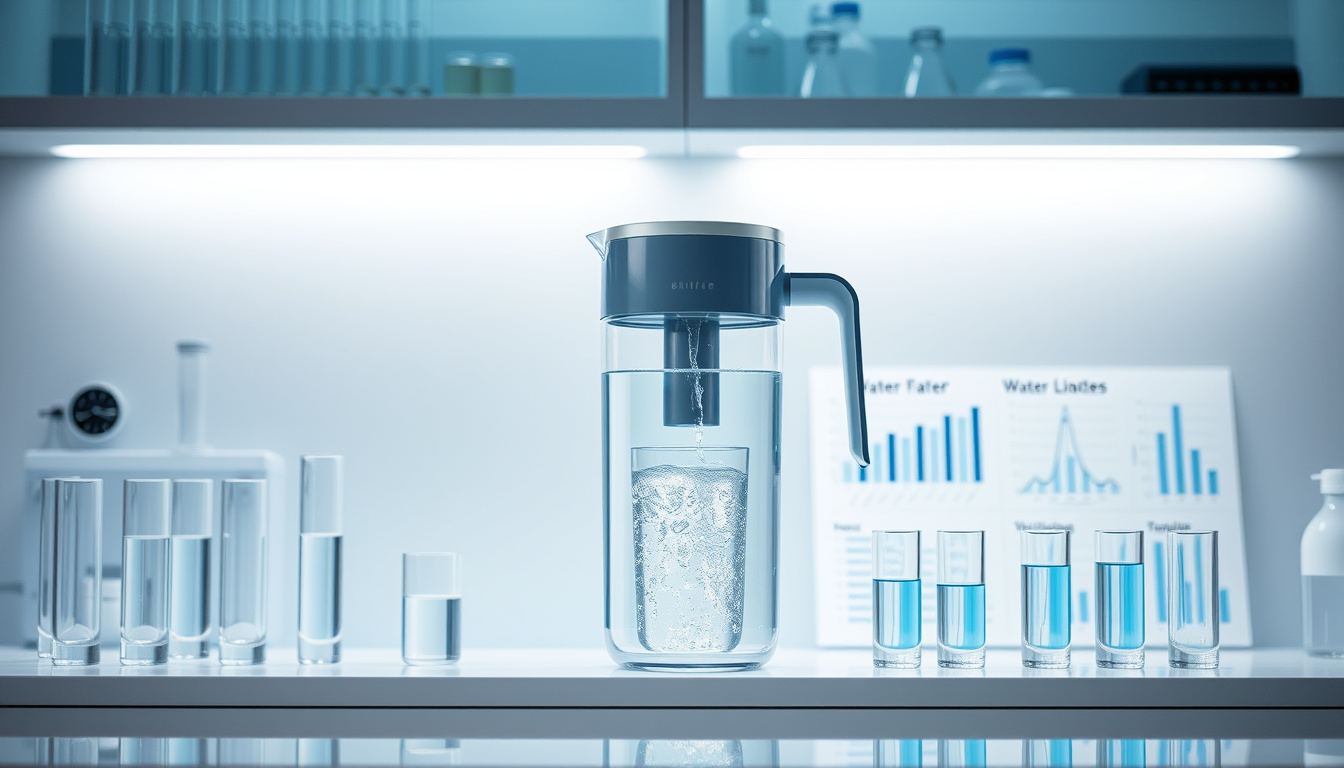
Recent lab tests expose a stark divide among water filter pitchers—some remove virtually all dangerous contaminants while others actually increase microplastics in your glass. With Consumer Reports testing 12 pitchers in 2026 and independent labs publishing scores out of 10, the gap between marketing promises and what actually happens under a microscope has never been clearer.
Top Scorer Contaminant Reduction: Clearly Filtered (8.24/10) · 100% Removal Rate: Waterdrop (lab tests) · Tested Contaminants Reduced: 100% (Epic Pure vs. peers) · Tested Pitcher Types: Glass and Plastic
Quick snapshot
- Waterdrop removed 100% of dangerous contaminants in lab testing (WaterFilterGuru)
- Clearly Filtered scored 8.24/10 for overall contaminant reduction (Independent Lab Tests)
- Exact Giardia removal performance across all pitcher brands
- Long-term microplastics reduction data beyond initial filter cycles
- Consumer Reports tested 12 pitchers in 2026 for taste, odor, and filtration (Consumer Reports)
- WaterFilterGuru published updated microplastics rankings in 2026 (Consumer Reports)
- NSF/ANSI 401 certification becoming the standard benchmark for microplastics claims
- Higher certification standards expected as consumer awareness grows
| Label | Value |
|---|---|
| Tested Top Performer | Clearly Filtered 8.24/10 |
| Max Contaminant Removal | Waterdrop 100% |
| Example TDS Reduction | 158 PPM post-filter |
| Key Concern: Giardia | Limited in Brita |
| Microplastics Pitcher | LifeStraw Home |
Do pitcher water filters actually work?
Water filter pitchers are designed to improve the taste and odor of potable water, not serve as primary purification systems. Independent testing from Consumer Reports confirms that 8 of 12 pitchers tested in 2026 do a very good job on taste and odor, though their effectiveness against specific contaminants varies dramatically between brands.
Effectiveness against common contaminants
- Heavy metals (lead, cadmium, mercury): All tested pitchers removed these at excellent levels
- Chlorine, fluoride, arsenic, TDS: Significant variation between brands
- Microplastics: Some pitchers actually increased microplastics after filtering
ConsumerLab testing on Aquagear, Brita, Clearly Filtered, and ZeroWater pitchers revealed big differences in how well they remove PFAS (“forever chemicals”). Some pitchers failed to reduce these compounds at all, while others achieved measurable reductions.
Lab test results overview
WaterFilterGuru’s 2026 lab testing showed AquaTru Carafe reducing 100% of all detected contaminants including fluoride, lead, uranium, barium, and molybdenum. Consumer Reports verified that Brita Denali with Elite filter, Culligan Zero Water ZD-012-RP, and ZeroWater Ready-Pour ZD-010RP are certified to NSF standards for lead, chlorine, and PFAS removal. A post-filtration TDS reading of 158 PPM demonstrates the mineral balance pitchers maintain while removing impurities.
Who makes the best water filtration pitcher?
After comparing lab-tested scores and certification data, two pitchers consistently outperform the field: Clearly Filtered and Waterdrop. Their approaches differ, but both deliver verifiable results that separate them from brands relying on vague “tested to” language.
Clearly Filtered vs. Epic Pure
Clearly Filtered scored 8.24/10 in independent lab testing, earning 4.5/5 for filtration performance. The pitcher was third-party tested against hundreds of substances to 200% of filter life, demonstrating sustained performance beyond typical usage cycles. Epic Pure achieved 100% reduction in tested contaminants, with particular strength in heavy metals and organic compounds.
“The AquaTru Carafe is the best overall water filter for reducing microplastics because it received the highest overall score in our testing.”
— WaterFilterGuru (Independent Review Site)
Waterdrop lab performance
Waterdrop pitchers achieved 100% removal of dangerous contaminants in WaterFilterGuru’s 2026 lab testing, with the AquaTru Carafe earning a 9.57 overall score and AquaTru Classic scoring 9.54. Both models use identical filtration technology certified by IAPMO to NSF/ANSI 42, 53, 58, 401, and 372 standards.
NSF/ANSI 401 specifically requires 85% reduction of microplastics 0.5-1 micrometer in size for certification. Brands with this seal have had their claims verified by independent laboratories, unlike “tested to” marketing language.
Which water filter pitcher removes the most contaminants?
Lab testing data reveals a clear hierarchy among pitchers when it comes to comprehensive contaminant removal. The difference between top and bottom performers isn’t marginal—scores range from 9.57 down to 6.59, reflecting genuine gaps in filtration technology.
Heavy metals and chemicals
ConsumerLab testing confirmed that all tested pitchers (Aquagear, Brita, Clearly Filtered, and ZeroWater) performed excellently on heavy metals including lead, cadmium, and mercury. However, performance diverged sharply on chlorine, fluoride, arsenic, and TDS. WaterFilterGuru found Culligan MaxClear removed 100% of zinc, phosphorus, fluoride, copper, uranium, and molybdenum while reducing barium by 97%, yet introduced manganese and dichloromethane and increased sulfate by 724.71%.
PFAS and microplastics
The most significant gaps emerged in PFAS (“forever chemicals”) and microplastics removal. British Berkefeld with Ultra Sterasyl reduced 100% of uranium, chlorine, copper, and molybdenum, but only achieved 70% nitrate removal and no fluoride removal. Brita Elite, despite its lower 6.59 overall score, is the only tested water filter pitcher with official microplastics reduction certification (NSF/ANSI 401, WQA, and IAPMO for VOCs/PFOA/PFOS).
“The Brita Elite might not be in our top roundup of the best water filter pitchers, but it is the only water filter pitcher we’ve tested that has an official microplastics reduction certification.”
— WaterFilterGuru (Independent Review Site)
What is the best water filter pitcher to avoid microplastics?
If avoiding microplastics is your priority, the certification landscape is surprisingly narrow. Only pitchers with NSF/ANSI 401 certification have verified microplastics reduction claims, and among pitchers, Brita Elite stands alone with this credential.
Glass pitcher options
LifeStraw Home offers a glass pitcher design that eliminates plastic leaching concerns entirely. For those prioritizing both material safety and filtration, British Berkefeld’s gravity filter system with Ultra Sterasyl certification provides an alternative approach, though its 85% microplastics reduction falls short of the 100% reduction achieved by countertop systems.
Filtration tech comparison
ZeroWater claims 99% microplastics reduction, but this figure comes from customer service responses rather than independent lab testing. WaterFilterGuru testing found that ZeroWater faucet filters reduce microplastics but the pitcher does not. The certified standard requires 85% reduction of particles 0.5-1 micrometer—anything below that threshold cannot carry the NSF/ANSI 401 seal.
Brita Elite’s 6.59 overall score reflects limited effectiveness against certain contaminants beyond microplastics. AquaTru Carafe’s 9.57 score demonstrates superior all-around performance, but at $349+ versus Brita Elite’s $40.99, cost and intended use matter enormously.
Does Brita remove Giardia?
Brita filters are not designed to remove bacteria or parasites like Giardia. The standard Brita filter uses activated carbon media optimized for taste and odor improvement, not for microbiological purification. Consumer Reports explicitly states that pitchers are intended to improve taste and odor of potable water—not serve as primary purification against biological contaminants.
Bacteria and parasite effectiveness
No standard pitcher filter on the market carries certification for Giardia or bacteria removal at meaningful levels. Water filter pitchers lack the technology (typically UV or reverse osmosis) needed for reliable microbiological reduction. If Giardia or bacteria are concerns in your water supply, a pitcher filter is not the appropriate solution regardless of brand.
Reasons to switch from Brita
- Brita Elite has microplastics certification that standard Brita lacks
- Brita does not remove Giardia, bacteria, or parasites
- Brita’s standard filter performance on PFAS varies significantly between models
- Some pitchers increase microplastics after filtering (ConsumerLab warning)
Consumer Reports advises verifying certifications from NSF, WQA, or IAPMO before purchasing. Avoid “tested to” claims without a certification seal—these indicate the brand has not submitted to independent verification.
Comparison: Top Water Filter Pitchers
Three brands dominate the certified filtration space with verifiable lab performance and third-party certifications.
| Brand | Overall Score | Key Certifications | Price Range |
|---|---|---|---|
| AquaTru Carafe | 9.57/10 | NSF/ANSI 42, 53, 58, 401, 372 | $349+ |
| Clearly Filtered | 8.24/10 | Third-party tested to 200% life | $80-120 |
| Brita Elite | 6.59/10 | NSF/ANSI 401, WQA, IAPMO | $40.99 |
| Culligan MaxClear | 8.55/10 | NSF 42, 53, 401 | $80-100 |
The range in scores from 6.59 to 9.57 translates to real-world performance gaps that buyers cannot ignore.
Specifications at a Glance
Five key metrics separate premium pitchers from budget options when you look at the lab data rather than the marketing copy.
| Specification | Premium Performance | Standard Performance |
|---|---|---|
| Microplastics Reduction | 85%+ certified (NSF/ANSI 401) | Variable, often unverified |
| Contaminant Coverage | 100% health-related compounds | Selective reduction |
| Filter Life Rating | Tested to 200% standard life | Standard cycle only |
| Cost per Gallon | $0.19 (AquaTru) | $1.20-$1.58 (Culligan) |
| Warranty | 1-5 years | Limited or none |
| Certification Bodies | NSF, WQA, IAPMO verified | “Tested to” claims only |
Buyers should weigh certification breadth against upfront cost when choosing between premium and standard tiers.
Upsides
- AquaTru Carafe achieved 100% contaminant reduction in independent lab testing
- NSF/ANSI 401 certification provides verifiable microplastics reduction
- Consumer Reports confirms 8 of 12 pitchers do very good job on taste/odor
- Clearly Filtered tested to 200% filter life shows sustained performance
- Brita Elite offers affordable certified microplastics removal at $40.99
Downsides
- Some pitchers increase microplastics after filtering
- Culligan MaxClear introduced manganese, dichloromethane, and 724.71% more sulfate
- No pitcher removes Giardia or bacteria reliably
- ZeroWater pitcher does not reduce microplastics despite faucet filter claims
- Premium certified pitchers cost $349+ (AquaTru Carafe)
What the Lab Data Tells Us
The gap between certified performance and marketing claims is substantial. ConsumerLab found that Aquagear, Brita, Clearly Filtered, and ZeroWater pitchers showed big differences in PFAS removal—not all brands reduce these “forever chemicals” equally.
Be aware that some pitchers actually increase the amount of microplastics in water after filtering. This finding from ConsumerLab underscores why certification seals from NSF, WQA, or IAPMO matter more than any marketing claim.
For US buyers, the certification ecosystem provides clear guidance: look for the NSF/ANSI 401 seal if microplastics reduction is your goal, verify PFAS claims through the same standard, and understand that pitchers improve taste and odor but are not primary purification systems.
Related reading: Stanley Quenchers and Tumblers · Smeg Toaster and Kettle
While Brita pitchers showed limits on Giardia and microplastics in lab tests, Brita cartridge replacements deliver the cheapest deals and maintenance tips.
Frequently asked questions
Is there a downside to drinking filtered water?
Filtered water removes beneficial minerals alongside contaminants, potentially altering your water’s mineral balance. Additionally, pitchers do not remove all contaminants reliably—PFAS, Giardia, and bacteria require different technology. Using filtered water exclusively without understanding your source water quality means you may be missing specific threats pitchers cannot address.
What is the best glass water filter pitcher?
LifeStraw Home offers an award-winning glass pitcher design that eliminates plastic leaching concerns. British Berkefeld’s Ultra Sterasyl system provides glass housing with certified filtration, though its 85% microplastics reduction falls short of countertop systems. Glass pitchers suit those prioritizing material safety alongside filtration quality.
What is the healthiest water filter pitcher?
AquaTru Carafe earns the highest overall score (9.57) with 100% contaminant reduction and full NSF/ANSI certification including 401 for microplastics. For microplastics specifically, Brita Elite is the only certified pitcher option at $40.99. “Healthiest” depends on your primary concern—certification and lab scores provide objective answers.
Do pitcher water filters improve taste?
Consumer Reports confirms 8 of 12 pitchers tested in 2026 do a very good job on taste and odor improvement. Post-filtration TDS readings of 158 PPM demonstrate maintained mineral balance that contributes to better flavor. All tested pitchers removed heavy metals excellently, which affects taste directly.
How often to replace water filter pitcher cartridges?
Replacement frequency varies by brand, usage, and source water quality. Clearly Filtered was tested to 200% of standard filter life, indicating sustained performance beyond typical cycles. Check your manufacturer’s specifications and consider testing your water monthly to gauge filter effectiveness.
Are glass water filter pitchers better?
Glass pitchers eliminate plastic leaching concerns and maintain filtration quality without . However, they require careful handling and may lack the advanced filtration technology found in some plastic-bodied systems. The “better” choice depends on whether material safety or maximum contaminant removal is your priority.
What contaminants do most pitchers miss?
Standard pitchers often fail to reduce PFAS (“forever chemicals”), microplastics below 0.5 micrometer, Giardia, bacteria, and certain organic compounds. ConsumerLab found some pitchers actually increased microplastics after filtering. NSF/ANSI 401 certification specifically addresses microplastics 0.5-1 micrometer—few pitchers carry this seal.
Which pitchers have NSF certification for microplastics?
Brita Elite is the only tested water filter pitcher with official microplastics reduction certification (NSF/ANSI 401, WQA, and IAPMO for VOCs/PFOA/PFOS). AquaTru Carafe and British Berkefeld systems carry NSF/ANSI 401 certification for countertop units but not all pitcher-form factor products.