
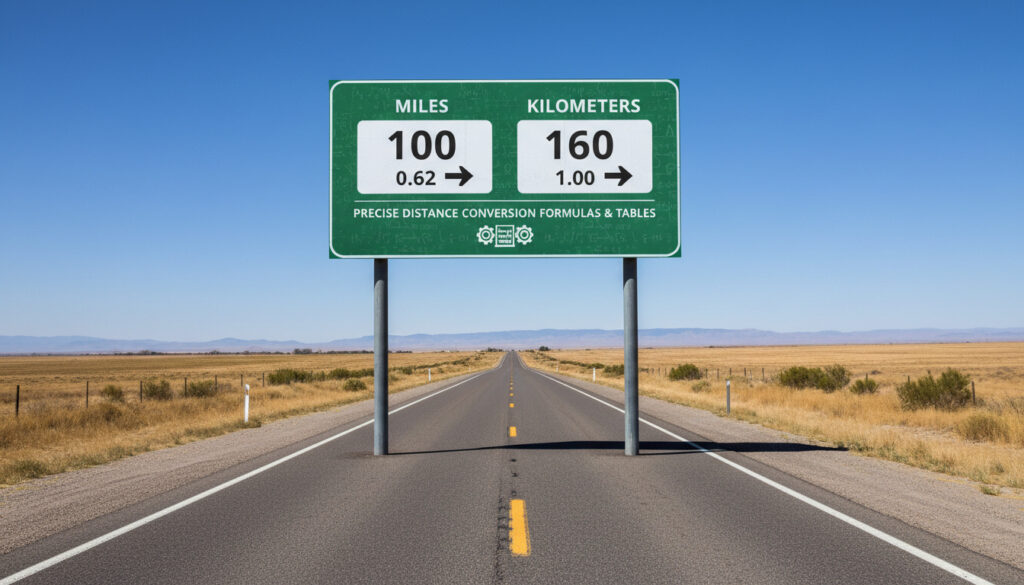
One statute mile equals exactly 1.609344 kilometers. This conversion factor serves as the international standard for translating imperial distance measurements into the metric system used by most countries worldwide.
Drivers crossing borders, runners tracking personal records, and logistics managers calculating fuel consumption all encounter this conversion regularly. The relationship between these units stems from the 1959 international agreement that standardized the inch as exactly 25.4 millimeters, thereby fixing the mile at 1,609.344 meters.
Understanding both the precise formula and practical estimation methods enables quick mental calculations without calculator dependency.
How Many Kilometers Are in a Mile?
Exact conversion factor
Standard calculation
Travel, fitness, engineering
Reciprocal factor
The statute mile contains exactly 1,609.344 meters, making the kilometer conversion precise to six decimal places according to Inch Calculator. This standardization eliminates the fractional variations that plagued historical survey measurements.
- Multiplying any mileage figure by 1.6 provides a close approximation suitable for everyday travel planning.
- GPS navigation systems typically display both units simultaneously to accommodate international users.
- Marathon racing standardized the 42.195-kilometer distance (26.2 miles) using this exact conversion ratio.
- Fuel economy ratings require careful conversion, as miles per gallon and liters per 100 kilometers represent inverse efficiency relationships.
- The nautical mile differs significantly, measuring 1.852 kilometers based on geospatial coordinates rather than land distance.
- Surveyors historically used slightly varying definitions before the 1959 international yard and pound agreement eliminated ambiguity.
- Scientific research universally employs kilometers to ensure reproducibility across international laboratories.
| Miles | Kilometers (Exact) | Common Context |
|---|---|---|
| 1 | 1.609344 | Base unit conversion |
| 2 | 3.218688 | Short commute |
| 5 | 8.04672 | Fun run distance |
| 10 | 16.09344 | Training run |
| 20 | 32.18688 | Half marathon |
| 50 | 80.4672 | Highway driving |
| 100 | 160.9344 | Long-distance travel |
How to Convert Miles to KM
Converting distances from miles to kilometers requires applying a single multiplication factor. The process remains consistent regardless of the distance magnitude, from short sprints to cross-country drives.
The Precise Formula
Multiply the number of miles by 1.609344 to obtain the exact kilometer equivalent. For example, 5 miles multiplied by 1.609344 equals 8.04672 kilometers. This formula applies to all statute miles, the standard unit for road distances in the United States and United Kingdom.
Mental Calculation Shortcuts
For situations requiring quick estimates without calculator access, multiplying by 1.6 yields results accurate within one percent. To calculate 50 miles, multiply 50 by 1 (50) and 50 by 0.6 (30), then add the results for an approximate 80 kilometers as demonstrated in educational video guides. This method suits travel planning where exact precision remains unnecessary.
Use the full 1.609344 factor for scientific, engineering, or athletic record-keeping applications. The 1.6 shortcut works adequately for fuel estimates and arrival time calculations during casual travel.
Miles to KM Examples and Calculator
Practical applications demonstrate how the conversion functions across different scales. These verified examples illustrate the formula in action.
Everyday Distance Conversions
A standard 5-mile run converts to exactly 8.04672 kilometers, a common training distance for recreational athletes according to Cuemath conversion tables. Two statute miles equal 3.218688 kilometers, roughly the distance from a suburban home to a nearby school SplashLearn educational resources note.
For longer commutes, 8.2 miles translates to 13.1964208 kilometers, representing a typical daily drive for office workers as calculated in video tutorials. Fifty miles extends to 80.4672 kilometers, covering significant highway distances between city centers.
Reverse Conversion: Kilometers to Miles
To convert kilometers back to miles, divide by 1.609344 or multiply by 0.621371. Eight kilometers equals approximately 4.97097 miles when calculated precisely. This reverse calculation proves essential when interpreting European road signs for American drivers or analyzing international athletic performances.
KM vs Miles: Key Comparisons
Understanding the relative scale between these units prevents navigation errors and miscalculations. One kilometer equals 0.621371 statute miles, meaning the kilometer represents a shorter distance than the mile.
Which Unit Measures Longer?
One mile significantly exceeds one kilometer in length. Specifically, 1 kilometer equals only 62.1371 percent of a statute mile. When comparing identical numerical values, 5 miles represents approximately 8.05 kilometers, while 5 kilometers equals roughly 3.11 miles.
The Nautical Mile Distinction
Maritime and aviation contexts use the nautical mile, which differs entirely from the statute mile. One nautical mile equals exactly 1,852 meters or 1.852 kilometers, based on one minute of latitude at the equator per the International Bureau of Weights and Measures. This makes the nautical mile approximately 1.15078 statute miles or 1.852 kilometers.
Pilots and sailors must distinguish between statute miles and nautical miles. Using the wrong conversion in maritime navigation creates significant positioning errors, as the nautical mile exceeds the statute mile by roughly 241 meters.
The 1.609344 kilometer value originates from the 1959 international yard and pound agreement adopted by English-speaking nations. This definition aligns with the meter as maintained by the International Bureau of Weights and Measures standards.
When Did the Mile Standard Evolve?
The modern statute mile emerged through centuries of measurement refinement, consolidating various regional standards into the current precise definition.
- Roman Origins: The Roman mile (mille passuum) measured approximately 1,480 meters, based on 1,000 paces of a Roman legion.
- English Statute: The British Parliament defined the statute mile as 5,280 feet or 8 furlongs during the reign of Queen Elizabeth I, standardizing land measurement.
- 1959 Agreement: The United States, United Kingdom, and other Commonwealth nations signed the international yard and pound agreement, fixing the inch at exactly 25.4 millimeters.
- Metric Alignment: This agreement established the statute mile as exactly 1,609.344 meters, creating the precise conversion factor used today.
What Is Certain About These Conversions?
Clear distinction between established facts and historical variations prevents confusion when interpreting distance references across different time periods and contexts.
| Established Facts | Historical Variations |
|---|---|
| 1 statute mile = 1.609344 kilometers exactly (since 1959) | Roman mile approximately 1.48 km (varied by region) |
| Forward formula: km = miles × 1.609344 | Pre-1959 survey feet varied slightly between nations |
| Reverse formula: miles = km ÷ 1.609344 | Nautical mile definition stabilized in 1929 (1.852 km) |
| Metric system base 10 (decimal) | Imperial fractional units (5,280 feet, 1,760 yards) |
Why Convert Miles to Kilometers?
International travel necessitates fluid conversion between these systems. While the United States maintains imperial road signage, most nations utilize kilometer-based distances. Athletic events such as the Leicester City Games 2024/25 Fixtures require standardized metric reporting for international competition compliance.
Fitness tracking applications automatically toggle between units based on user location, while scientific research universally employs kilometers to ensure global reproducibility. Automotive engineering specifications typically provide both measurements to accommodate diverse markets.
Where Do These Definitions Come From?
The conversion factor derives from international metrology agreements rather than approximation. The National Institute of Standards and Technology (NIST) and the International Bureau of Weights and Measures (BIPM) maintain these definitions through the International System of Units (SI).
The statute mile is legally defined as exactly 1,609.344 meters in the US customary and imperial systems, making the exact miles-to-kilometer factor 1.609344.
— Derived from international measurement standards NIST metric guidelines
This standardization ensures that a mile measured in London matches exactly the distance measured in New York or Sydney, eliminating the fractional variations that plagued historical surveys.
Quick Reference Summary
Remember that one statute mile equals exactly 1.609344 kilometers, with the reverse conversion using 0.621371. While precise calculations require the full six-decimal factor, multiplying by 1.6 serves most travel needs adequately. For kitchen precision similar to that found in the Kmart Food Processor Review, use the exact formula rather than estimates.
Frequently Asked Questions
Why do some countries use miles while others use kilometers?
Historical empire influence determined measurement adoption. British colonial territories retained imperial units, while continental Europe and most other nations adopted the metric system during the 19th and 20th centuries for scientific standardization.
What is a nautical mile in kilometers?
One nautical mile equals exactly 1.852 kilometers. This measurement differs from the statute mile and derives from one minute of latitude at the equator, used specifically in maritime and aviation navigation.
Is 2 kilometers longer than 1 mile?
No. One mile equals 1.609344 kilometers, making it longer than 2 kilometers (which equals 1.242742 miles). You would need approximately 3.22 kilometers to exceed 2 miles.
How accurate is the 1.6 estimation method?
Multiplying miles by 1.6 produces results accurate within 0.5 percent of the true value. For 100 miles, the estimate gives 160 km versus the exact 160.9344 km—sufficiently precise for fuel and time estimates.
When should I use exact conversion versus estimation?
Use exact conversion (1.609344) for scientific research, athletic record-keeping, engineering specifications, and legal documentation. Estimation suffices for casual travel planning and rough distance calculations.
Does the conversion factor ever change?
The 1.609344 factor has remained fixed since the 1959 international agreement. While the definitions of underlying units have evolved, this specific conversion ratio represents a permanent international standard.
Related stories




Sarah McKenzie is Managing Editor at Australia Current, overseeing daily newsroom workflow, commissioning and headline review.