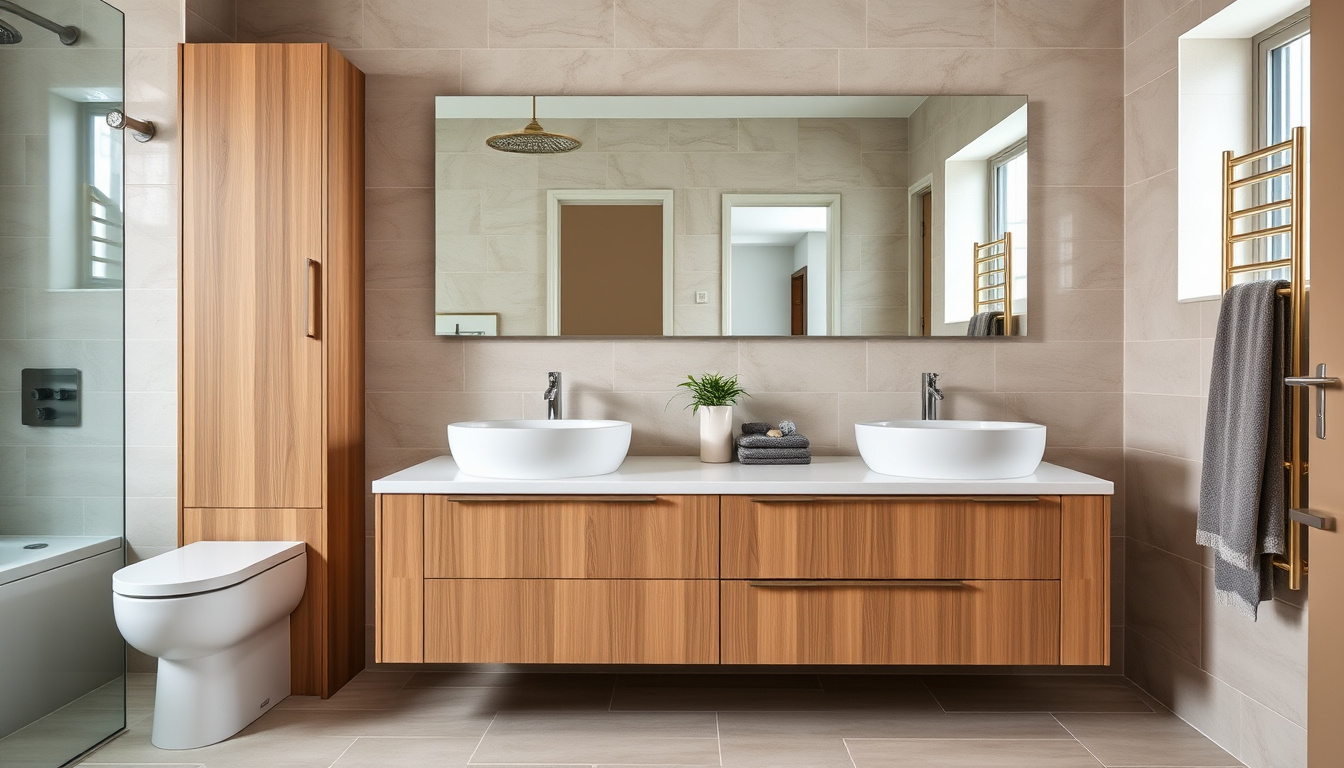
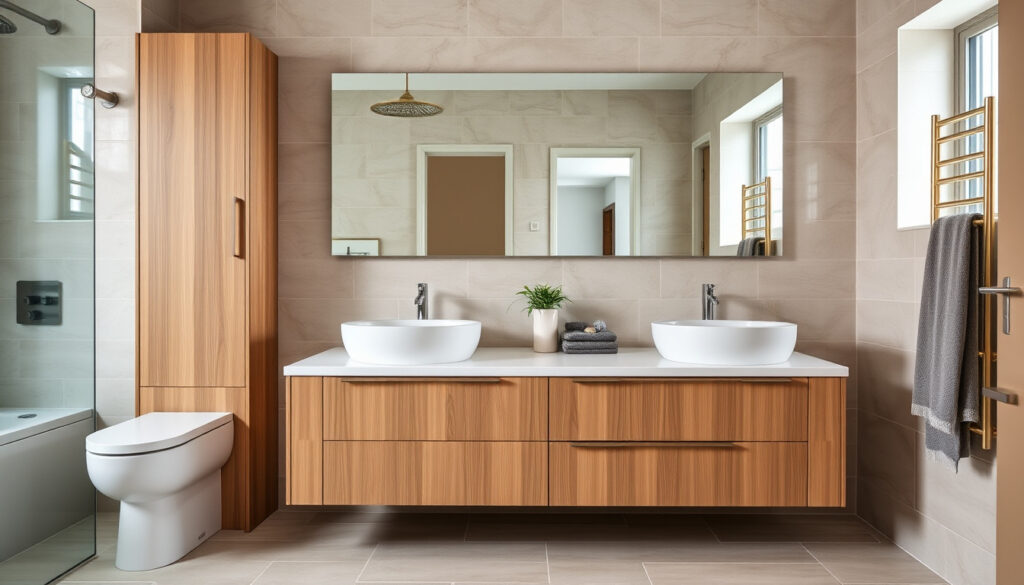
Anyone who has measured a bathroom in an Irish home knows that “standard size” is a flexible term. A vanity unit that looks perfect online can become a frustration when it doesn’t clear the door frame or leaves no room for the plumbing, but with widths from 60 cm to 120 cm, options from IKEA to specialist retailers, and clear guidance on materials and installation, finding the right fit is manageable.
Average width of a standard vanity unit: 60 cm · Typical depth range: 40–50 cm · Most common countertop material: Ceramic or marble · IKEA bathroom vanity models available: Over 20 · Price range for floor-standing units in Ireland: €150 – €1,200
Quick snapshot
- A bathroom vanity combines a sink with built-in storage. IKEA (product catalogue)
- Available in wall hung and floor standing styles. The Home Depot (measurement guide)
- Common in modern and traditional bathrooms across Ireland. Tubs & Tiles
- Widths: 60 cm, 80 cm, 100 cm, 120 cm. (The Home Depot)
- Depth: 40–50 cm. (The Home Depot)
- Height: 76–91 cm (standard vs. comfort). (The Home Depot)
- IKEA Ireland: 20+ models, €100+. (IKEA)
- Deluxe Bathrooms: designer stock. (Deluxe Bathrooms)
- Bath Shack: fast delivery Ireland/UK. (Bath Shack)
- Big Bathroom Shop: freestanding specialist. (Big Bathroom Shop)
- Tubs & Tiles: wide range with expert advice. (Tubs & Tiles)
- Particleboard/MDF (budget-friendly). (IKEA)
- Solid wood (premium durability). (The Home Depot)
- Ceramic/marble countertops (common finish). (The Home Depot)
Six key dimensions frame every vanity decision in an Irish bathroom. Here is what matters most:
| Dimension | Typical Value | Notes for Irish Homes |
|---|---|---|
| Standard width | 60 cm | Smallest common size for compact spaces |
| Common depth | 45 cm | Fits most alcove layouts |
| Height range | 76–91 cm | Standard vs. comfort height options |
| Countertop overhang | Up to 2.5 cm per side | Must factor into clearance |
| Side clearance needed | ~10 cm per side | Allows for countertop and fixtures |
| Price range Ireland | €150 – €1,200 | Budget to premium |
| IKEA warranty | 10 years | Covers most bathroom furniture |
| Budget material | MDF or particleboard | Common at entry-level price points |
What is a bathroom vanity unit?
A bathroom vanity unit is a piece of furniture that combines a sink with built-in storage, typically including a countertop, one or more basins, and cabinets or drawers below. According to IKEA (official product catalogue), the category covers everything from compact sink cabinets to large double vanity setups.
Key components: sink, storage, countertop
- Sink (basin): Integrated or drop-in, the sink is the primary functional element. IKEA (customer guidance) advises buyers to look for sink options that fit the sink cabinet, noting that some sinks are slightly larger than the cabinet because they overlap the edge.
- Storage: Drawers, shelves, or cupboards beneath the sink hold toiletries, towels, and cleaning supplies. Floor standing units generally offer larger storage than wall hung models.
- Countertop: Typically ceramic, marble, or engineered stone. The surface adds 1–2 cm on each side of the cabinet, which should be included in clearance measurements, as noted by The Home Depot (retail measurement guide).
Irish buyers who choose a vanity with an integrated sink gain a seamless look but lose the flexibility to swap the basin later. Separate tops give more design freedom at the cost of extra sealing work.
The implication: integrated sinks simplify maintenance, while separate tops offer adaptability for future updates.
What sizes do bathroom vanity units come in?
Three measurements dictate whether a vanity fits your bathroom: width, depth, and height. Standard widths include 60, 80, 100, and 120 cm, according to The Home Depot (retail measurement guide). Depth usually ranges from 40 to 50 cm, and comfort height models stand 86–91 cm tall while standard models measure 76–81 cm.
Common width sizes: 60 cm, 80 cm, 100 cm, 120 cm
- 60 cm: Fits small ensuites and cloakrooms. Often the narrowest off-the-shelf option available in Ireland.
- 80–100 cm: The most popular range for family bathrooms, balancing storage capacity with floor space.
- 120 cm: Suitable for larger bathrooms, often configured as a double vanity with two basins.
Depth considerations for small bathrooms
Depth is the measurement most often underestimated. A standard vanity depth of 45 cm means the unit protrudes nearly half a metre from the wall. The Home Depot recommends leaving about 10 cm of space on either side of the vanity to accommodate the countertop and fixtures. In a narrow bathroom, that can push the effective footprint to 65 cm of width.
Height options: standard vs. comfort height
Standard vanities sit 76–81 cm tall, roughly aligned with older counter heights. Comfort height models rise to 86–91 cm, matching modern kitchen counter levels and reducing back strain. The choice depends on who uses the bathroom. Comfort height works well in main family bathrooms; standard height may be better for children’s bathrooms or guest cloakrooms.
A vanity that looks like it will fit on paper can still fail the real-world test. Measure the door swing, check that drawers clear the toilet or towel rail, and always account for pipework behind the unit.
Where can I buy bathroom vanity units in Ireland?
Irish buyers have several reliable routes, from mass-market retailers to specialist showrooms. Each offers different price points, warranty terms, and delivery options.
IKEA Ireland bathroom vanities
IKEA (product catalogue) offers over 20 bathroom vanity models in Ireland, with prices starting around €100 for a basic unit. The Swedish retailer uses particleboard or MDF with melamine foil or lacquer finish for most units, and backs them with a 10-year warranty. IKEA (customer service) advises customers to use its Bathroom buying guides to find compatible sinks for each cabinet size.
Specialist retailers: Deluxe Bathrooms, Bath Shack, Big Bathroom Shop, Tubs & Tiles
- Deluxe Bathrooms (deluxebathrooms.ie): Stocks designer vanity units with a focus on contemporary styling and premium materials.
- Bath Shack (bathshack.com): Offers vanity units with fast delivery across Ireland and mainland UK. Their range includes both budget and mid-tier options.
- Big Bathroom Shop (bigbathroomshop.ie): Specializes in freestanding vanity units. Their product descriptions highlight solid construction and a variety of finish options.
- Tubs & Tiles (tubstiles.ie): Provides both wall hung and freestanding options with in-store expert guidance for customers unsure about sizing and installation.
Local Dublin suppliers
Dublin has several bathroom showrooms that stock floor-standing vanity units for immediate inspection. Shopping locally lets you check material quality in person and often arrange installation through the same supplier.
Are IKEA bathroom vanities good quality?
Material quality and durability
- IKEA vanities use particleboard or MDF with melamine foil or lacquer finish. These materials are moisture-resistant when properly sealed but can swell if exposed to standing water over time.
- Solid wood options are rare in IKEA’s range. The focus is on engineered boards that keep costs low while meeting basic bathroom durability standards.
Price vs. value comparison
Prices at IKEA Ireland start around €100 for a basic unit and rise to about €600 for larger models with integrated sinks and soft-close drawers. Against specialist retailers, IKEA offers lower entry prices but fewer premium material choices. IKEA (buying guides) provides planning tools that help customers select cabinet sizes compatible with specific sinks.
Customer reviews and warranty
IKEA offers a 10-year warranty on most bathroom furniture, covering manufacturing defects in cabinet construction and drawer mechanisms. Customer reviews frequently cite straightforward assembly as a positive, though some note that particleboard edges can chip during installation if handled roughly.
IKEA vanities deliver reliable function at a competitive price point for Irish buyers, but the 10-year warranty only covers defects — not damage from bathroom humidity. Proper ventilation remains the buyer’s responsibility.
The catch: IKEA’s warranty covers manufacturing defects, not environmental damage.
What is the difference between floor standing and wall hung vanity units?
Installation requirements and space savings
- Floor standing units rest on the floor and require no wall reinforcement. They are simpler to install but take up the full floor footprint.
- Wall hung units are mounted to the wall with brackets, creating the illusion of more floor space. They need a solid wall or additional framing for support, which adds installation complexity.
Storage capacity differences
Floor standing units generally offer larger storage because the cabinet extends to the floor. Wall hung models have a shallower profile and often sacrifice drawer depth for the slim silhouette. According to The Home Depot (retail measurement guide), plumbing fixtures can affect the placement, style, and size of a vanity — especially relevant for wall hung installations where pipework must be concealed.
Aesthetic and style preferences
Wall hung units create a clean, modern look and are easier to clean underneath. Floor standing units lean traditional and provide a solid visual anchor. Irish bathroom designers often recommend wall hung for small spaces because the exposed floor makes the room feel larger.
Bathroom vanity pros and cons
Upsides
- Combines sink and storage in one unit, saving space.
- Available in a wide range of widths (60–120 cm) to fit most bathrooms.
- IKEA models come with a 10-year warranty for peace of mind.
- Wall hung options make small bathrooms feel larger.
- Freestanding units offer generous drawer and cupboard space.
Downsides
- Compact units can have limited storage capacity.
- MDF and particleboard can swell if exposed to persistent moisture.
- Wall hung installation requires a solid wall or reinforcement.
- Integrated sinks limit future replacement options.
- Delivery lead times vary significantly between retailers in Ireland.
What this means: pros and cons highlight the trade-off between cost, space, and durability.
Bathroom vanity specifications
Seven spec points separate a vanity that works from one that frustrates. Here is the breakdown Irish buyers should check before ordering:
| Specification | Typical Value | Why It Matters |
|---|---|---|
| Cabinet width | 60–120 cm | Determines whether the unit fits the available wall alcove |
| Cabinet depth | 40–50 cm | Must leave clear floor space for movement and door opening |
| Cabinet height | 76–91 cm | Comfort height (86–91 cm) reduces bending; standard suits children |
| Countertop material | Ceramic, marble, engineered stone | Affects durability, cleaning ease, and cost |
| Cabinet material | MDF, particleboard, solid wood | Solid wood resists moisture best; MDF is budget-friendly |
| Finish type | Melamine foil, lacquer, paint | Lacquer offers the best moisture barrier |
| Sink type | Integrated, drop-in, undermount | Integrated sinks simplify cleaning; undermount offers a sleek look |
| Warranty | 1–10 years | IKEA offers 10 years; specialist retailers vary |
The pattern: checking all seven specs prevents costly errors – especially width, depth, and warranty.
What we know and what remains unclear
Confirmed facts
- IKEA offers a 10-year warranty on bathroom furniture. (IKEA product catalogue)
- Standard vanity widths are 60, 80, 100, and 120 cm. (The Home Depot measurement guide)
- IKEA provides dedicated buying guides for sink-cabinet compatibility. (IKEA customer guidance)
- Countertop overhang adds up to 2.5 cm per side to the unit footprint. (The Home Depot measurement guide)
What’s unclear
- Exact number of total vanity models available in Ireland across all retailers.
- Average customer satisfaction scores for Irish specialty retailers.
- Long-term durability comparison between IKEA particleboard and specialist solid wood units in Irish bathroom conditions.
- Typical installation costs across different counties in Ireland.
- Bath Shack delivery speed and reliability claims lack independent verification.
“If you’re choosing between wall hung and floor standing, the first question should be about your wall construction. A hollow partition wall isn’t suitable for a heavy vanity without reinforcement.”
— Tubs & Tiles staff, expert guidance
“A freestanding unit with a solid top and soft-close drawers gives you the best daily experience for the money. Look for one sealed on all sides, not just the visible faces.”
— Big Bathroom Shop product description
The implication: wall construction often dictates the feasibility of wall-hung units, while finish quality separates good from great.
For a detailed look at the latest styles and sizes available, see our comprehensive buying guide for 2025 prices and top retailers.
Frequently asked questions
How do I measure my bathroom for a vanity unit?
Measure the width of the alcove or wall space, the depth from the wall to the nearest obstruction, and the height from floor to counter. The Home Depot (retail measurement guide) recommends leaving about 10 cm of clearance on each side of the vanity and checking the door swing path.
What is the best material for a bathroom vanity in Ireland?
Solid wood offers the best moisture resistance and durability but costs more. MDF with a lacquer finish is a practical mid-range option. Particleboard with melamine foil works for budget installations but is less tolerant of humidity.
Can I install a bathroom vanity unit myself?
Yes, if you are comfortable with basic plumbing and wall fixing. Floor standing units are easier to install solo. Wall hung units require a solid wall and careful levelling. Connecting the water supply and waste pipe may require a licensed plumber depending on local regulations.
Are there vanity units with integrated sinks?
Yes. Many compact and mid-range vanity units come with an integrated ceramic or marble top that includes the basin. These are easy to clean and eliminate the seam between sink and countertop. The trade-off: the sink cannot be replaced separately.
What is the most durable finish for a vanity unit?
Lacquer finishes provide the best moisture barrier, followed by high-pressure melamine. Painted finishes can chip and may require touch-ups in humid bathrooms. Always check that the manufacturer seals all cut-outs and edges.
Do I need a plumber to install a vanity unit?
Connecting water supply lines and waste pipes typically requires plumbing skills. If you are replacing an existing unit on the same plumbing rough-in, a confident DIYer can manage. New plumbing runs or wall hung installations almost always need a professional.
Related reading
- Double Bed: Size, Suitability and Replacement Guide
- Kids Bunk Beds: Age Guide, Safety Tips & Irish Picks
What this means: sizing guides for home furniture follow similar measurement logic – always verify dimensions before buying.
Choosing a bathroom vanity in Ireland comes down to matching three things: your available width, your storage needs, and your budget. IKEA offers the broadest choice and a decade of warranty coverage, but specialist retailers like Deluxe Bathrooms and Tubs & Tiles provide material quality and fitting advice that can save costly mistakes. For Irish buyers renovating a compact bathroom, the smart move is a 60–80 cm wall hung unit with a sealed lacquer finish — because every centimetre and every seal counts.
Related stories



Ryan Hughes is Senior Reporter at Australia Current, covering breaking stories and explainers.