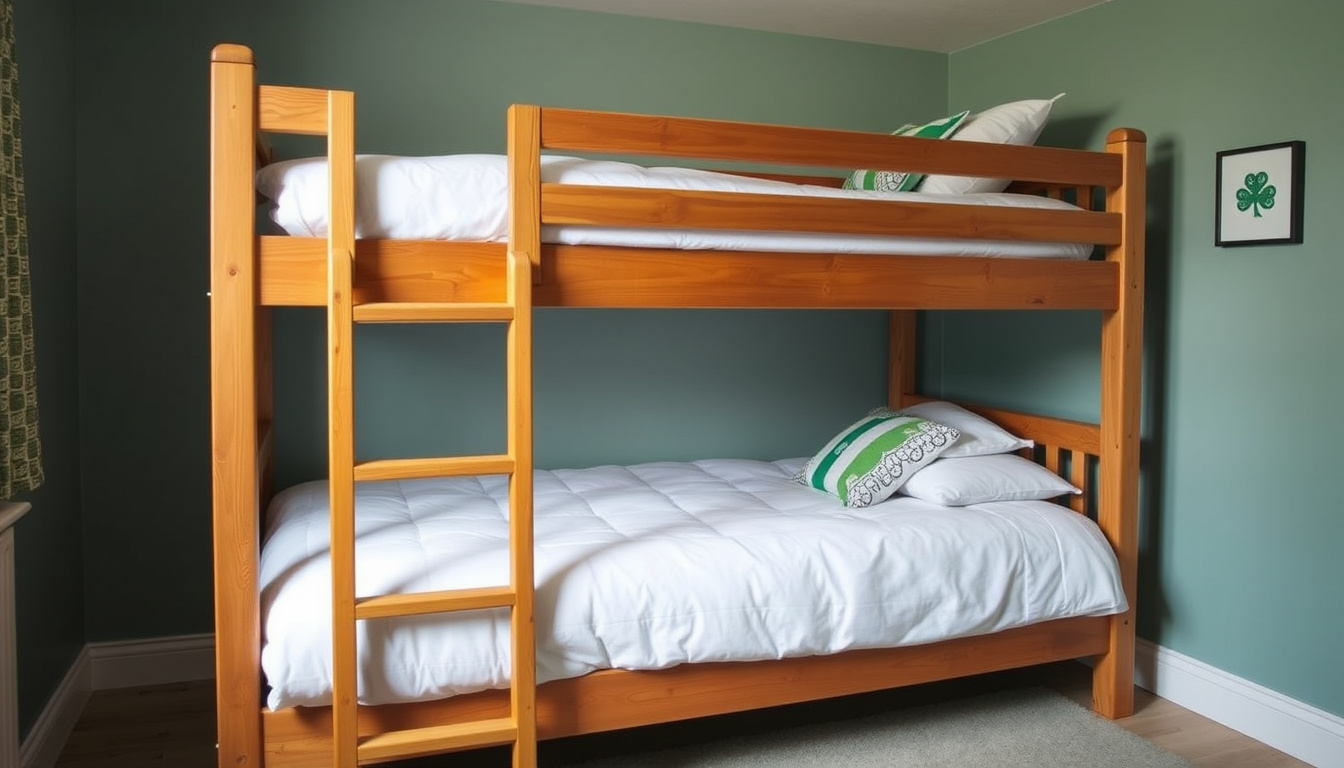
Few things spark a child’s excitement like a bunk bed—but for Irish parents, that excitement comes with a big question: is it safe? With the right age guidelines and a solid safety check, a bunk bed can be one of the smartest space-saving buys you make.
Minimum age for top bunk: 6 years (Health Canada recommendation) ·
Annual bunk bed injuries in the US: Around 36,000 (CPSC) ·
Space saved by a bunk bed: 30–50% floor space ·
Popular Irish retailers: Deskelly, Ogel Beds, Lowneys, MK Furnishings ·
Weight limit for standard kids bunk beds: 150–250 lbs per bunk
Quick snapshot
- Children under 6 should not sleep in the top bunk (Health Canada (Canadian regulator))
- Bunk beds cause roughly 36,000 injuries annually in the U.S. (Happiest Baby (citing CPSC data))
- Guardrails must extend at least 5 inches above the mattress on all sides (Health Canada (Canadian regulator))
- Exact age for lower bunk use depends on child’s maturity and motor skills (ACCC Product Safety (Australian regulator))
- Weight limits vary by manufacturer and model – always check the label (ACCC Product Safety (Australian regulator))
- ACCC published an updated bunk bed safety guide in June 2023 (ACCC Product Safety)
- Check for recall notices on the European Commission’s Safety Gate portal
- Reassess as your child grows: maturity, not just age, determines readiness
Here’s a quick overview of the essential numbers.
| Label | Value |
|---|---|
| Minimum age for top bunk | 6 years (Health Canada) |
| Common bunk bed injury | Falls from ladder or top bunk |
| Weight limit typical range | 150–250 lbs per bunk |
| Popular Irish retailers | Deskelly, Ogel Beds, Lowneys, MK Furnishings |
| Space saving average | 30–50% floor space freed |
| Guardrail height minimum | 5 inches (12.7 cm) above mattress |
| Mattress size standard | 90 cm x 190 cm (UK/Irish single) |
| EN 747 compliance | Required in Europe – look for label |
The numbers paint a clear picture: safety starts with age, but the real gains come from knowing which bed type fits your child’s room and routine.
What is the recommended age for a kids bunk bed?
General age guidelines from safety authorities
- Health Canada, a national health regulator, advises that no child under 6 years old should be on the top bunk at any time (Health Canada).
- The U.S. Consumer Product Safety Commission (CPSC) requires warning labels stating that no child under six should sleep in the top bunk (Happiest Baby citing CPSC).
- The Australian Competition and Consumer Commission (ACCC) goes further, recommending the top bunk not be used by children under 9 years old (ACCC Product Safety).
Europe’s own standard, EN 747, aligns broadly with the 6-year threshold, meaning Irish parents can treat this as a firm baseline.
Can a 7 year old sleep in a bunk bed?
Yes, a 7‑year‑old can safely sleep in the top bunk if the bed meets safety standards and the child is mature enough to climb carefully. The ACCC notes that suitability depends on the child’s development and motor skills (ACCC Product Safety). Check that guardrails are on all four sides (even against a wall) and that the ladder is securely attached (Health Canada).
Factors that affect readiness beyond age
- Motor coordination: can your child climb up and down without hesitation?
- Night‑time behaviour: do they stay in bed or wander?
- Height and weight: ensure they are within the bed’s weight limit (typically 150–250 lbs).
The implication: age is a starting point, not a guarantee. Observe your child’s habits before handing over the top bunk.
Can you put a 3 year old in a bunk bed?
Risks for toddlers in bunk beds
Most safety experts strongly advise against bunk beds for children under 4. Falls from the top bunk or ladder are the leading cause of injury. The CPSC reports roughly 36,000 bunk‑bed related injuries each year in the U.S., a disproportionate number involving toddlers (Happiest Baby citing CPSC data). Health Canada also warns that cords and scarves near bunk beds can pose a strangulation risk (Health Canada).
Alternative sleeping arrangements for 3-year-olds
A low toddler bed or a standard single bed on the floor is far safer. If space is tight, consider a trundle bed that sits close to the ground. The lower bunk of a bunk bed, while still low, is not recommended for a 3‑year‑old without careful supervision and guardrails.
When might a 3 year old use a lower bunk?
Only if the lower bunk has guardrails, the mattress sits close to the floor, and an adult is present at night. Even then, the ACCC recommends removing the ladder when not in use to stop small children from climbing up (ACCC Product Safety).
The trade-off: no bunk bed is truly “safe” for a toddler. A separate low bed removes every risk.
Is it safe to put a 4 year old in a bunk bed?
Safety checklist for 4-year-olds
- Only the lower bunk – the top is off‑limits until age 6 (CPSC standard).
- Guardrails on all sides, at least 5 inches above mattress (Health Canada).
- Ladder securely attached and no loose screws or bolts.
- No cords, blinds, or accessories near the bed.
Top bunk vs. lower bunk considerations
A 4‑year‑old should absolutely not use the top bunk. The CPSC warning labels apply to all children under 6. The lower bunk, with proper guardrails, may be considered if the child shows good coordination and does not jump or play on the bed.
Common bunk bed injuries and prevention
- Falls from the top bunk or ladder (most common).
- Entrapment between guardrails and mattress.
- Strangulation from drawstrings or cords (Health Canada).
Why this matters: a 4‑year‑old’s body is still developing – a fall from even a low bunk can cause serious injury. Use the lower bunk only as a last resort.
Warning: The CPSC and Health Canada both stress that children under 6 should never be on the top bunk. Even with supervision, a fall can cause serious injury.
What are the disadvantages of bunk beds?
Safety risks and injury statistics
Bunk beds have a higher injury rate than standard beds, with an estimated 36,000 emergency room visits per year in the U.S. alone (Happiest Baby citing CPSC). The risk is highest for children under 6.
Difficulty making the bed and changing sheets
Unless you buy a model with split mattresses or an easy‑access design, changing sheets on the top bunk is awkward. Many parents end up leaving the top bed unmade for weeks.
Limited ceiling height for top bunk
In many Irish homes with standard ceiling heights (2.4 m), the top bunk can leave only 70–80 cm of headroom. That’s fine for sleeping but not for sitting up or playing. The ACCC also advises that children should not jump or play on the bunk (ACCC Product Safety).
Potential for arguments between siblings
Sibling squabbles over the top bunk, turning night lights on/off, and general territorial behaviour are real. A bunk bed can make shared rooms more tense.
The catch: the space you save might be offset by the daily friction. Weigh the trade‑off before committing.
What is the best bunk bed for kids?
Choosing the right type depends on your child’s age, room size, and how you plan to use the space.
| Type | Best for | Key features | Space saving |
|---|---|---|---|
| Bunk beds with storage | Children under 8, small bedrooms | Built-in drawers or shelves, reduces clutter | 30–50% floor space freed |
| Bunk beds with desk | School-age children (6+), study area needed | Desk width 100–120 cm, cable management | Combines bed and desk in one footprint |
| Low bunk beds (trundle/twin over twin) | Younger children (4–6) on lower bunk, safety priority | Lower height, often convertible to two singles | Frees floor space, lower fall risk |
Top-rated bunk beds in Ireland
Irish parents have strong options from local retailers. Deskelly, Ogel Beds, Lowneys, and MK Furnishings all stock models that meet European safety standard EN 747. Popular lines include the Berkley storage bunk and the Staircase bunk with built‑in drawers.
Bunk beds with storage: pros and features
- Built‑in drawers or shelves – ideal for small bedrooms.
- Reduces clutter and keeps toys off the floor.
- Typical drawer depth: 40–50 cm.
Bunk beds with desk: space-saving combo
- Combines sleeping and study area – perfect for school‑age children.
- Desk width usually 100–120 cm.
- Look for models with integrated cable management.
Bunk beds from IKEA and other brands
IKEA offers several kids bunk beds, such as the Kura (reversible low/high) and Mydal (twin over twin). They are affordable and meet EU safety standards. The catch: IKEA mattresses are non‑standard sizes – check the exact dimensions before buying.
The pattern: the “best” bunk bed depends on your child’s age, room size, and whether storage or a desk is the priority. Storage bunks work for younger kids; desk combos suit school‑goers.
Irish parents get the best value by matching the bunk type to the child’s age and the room’s limitations – a storage bunk for a cluttered small room, a desk bunk for a student, and a low bunk for a younger child.
Upsides
- Frees 30–50% floor space
- Fun for kids – sleepovers and imaginary play
- Many models convert to two separate beds later
- Built‑in storage/desk options reduce extra furniture
Downsides
- Higher injury risk, especially under age 6
- Hard to make the top bed
- Limited headroom on top
- Sibling arguments over sleeping position
The pattern: the best choice balances safety, space, and sibling harmony.
Confirmed facts
- Children under 6 should not sleep in the top bunk – supported by Health Canada, CPSC, and ACCC.
- Guardrails must be at least 5 inches above mattress on all sides (Health Canada).
- Only one person should be on the top bunk at a time (Health Canada).
What’s unclear
- Exact age for lower bunk alone depends on child’s development – no universal rule.
- Long‑term impact of sharing a bunk on sibling dynamics is anecdotal.
- There is no global consensus on minimum age: ACCC recommends 9, while CPSC/Health Canada recommend 6.
“No child under six years old should be on the top bunk at any time.”
Health Canada (Canadian regulator)
“Bunk beds account for thousands of injuries each year, mostly from falls.”
U.S. Consumer Product Safety Commission (via Happiest Baby)
The evidence is clear: age and maturity are the twin filters. For Irish parents, the decision is not whether to buy a bunk bed, but which one – and when. Choose a low bunk or a storage model for children under 6, and reserve the desk bunk for school‑age kids. That’s the formula that saves space without sacrificing safety.
thebeanbagstore.com, maxtrixkids.com, rafa-kids.com, maxandlily.com
For a detailed breakdown of age recommendations and safety standards, check out this bunk bed safety guide tailored for Irish families.
Frequently asked questions
Do bunk beds require a specific mattress size?
Yes, most bunk beds use standard UK/Irish single mattress sizes (90 cm x 190 cm). Always check the manufacturer’s specifications, as some IKEA models use 80 cm x 200 cm.
How to childproof a bunk bed?
Add guardrails on all four sides, secure the ladder, remove cords near the bed, and tighten all screws regularly. Health Canada also advises tying up blind cords out of reach (Health Canada).
Are metal or wooden bunk beds safer?
Both can be safe if they meet EN 747 standards. Wooden bunks are heavier and less likely to tip; metal bunks are lighter but can sway. Weight capacity is often higher in metal frames.
What is the weight limit for kids bunk beds?
Typical weight limits range from 150 to 250 lbs per bunk, but this varies by model. Always check the manufacturer’s label.
Can bunk beds be separated into two beds?
Many twin‑over‑twin bunk beds are designed to be separated into two standalone single beds. Check the product description before buying.
Are bunk beds with stairs safer than ladders?
Stairs are generally safer for younger children because they offer better footing. Some models also include storage drawers in the stairs.
How to choose the best bunk bed for a small room?
Measure the ceiling height (minimum 2.4 m for a top bunk). Choose a model with storage drawers or a desk to maximise floor space. Avoid high bunks in rooms with sloped ceilings.
Do bunk beds come assembled or flat-pack?
Most Irish retailers offer flat‑pack delivery. Some (e.g., Deskelly, Ogel Beds) offer assembly services for an extra fee. IKEA bunks are always flat‑pack.
Related stories



Rachel Bennett leads fact-checking, source verification and corrections at Australia Current.