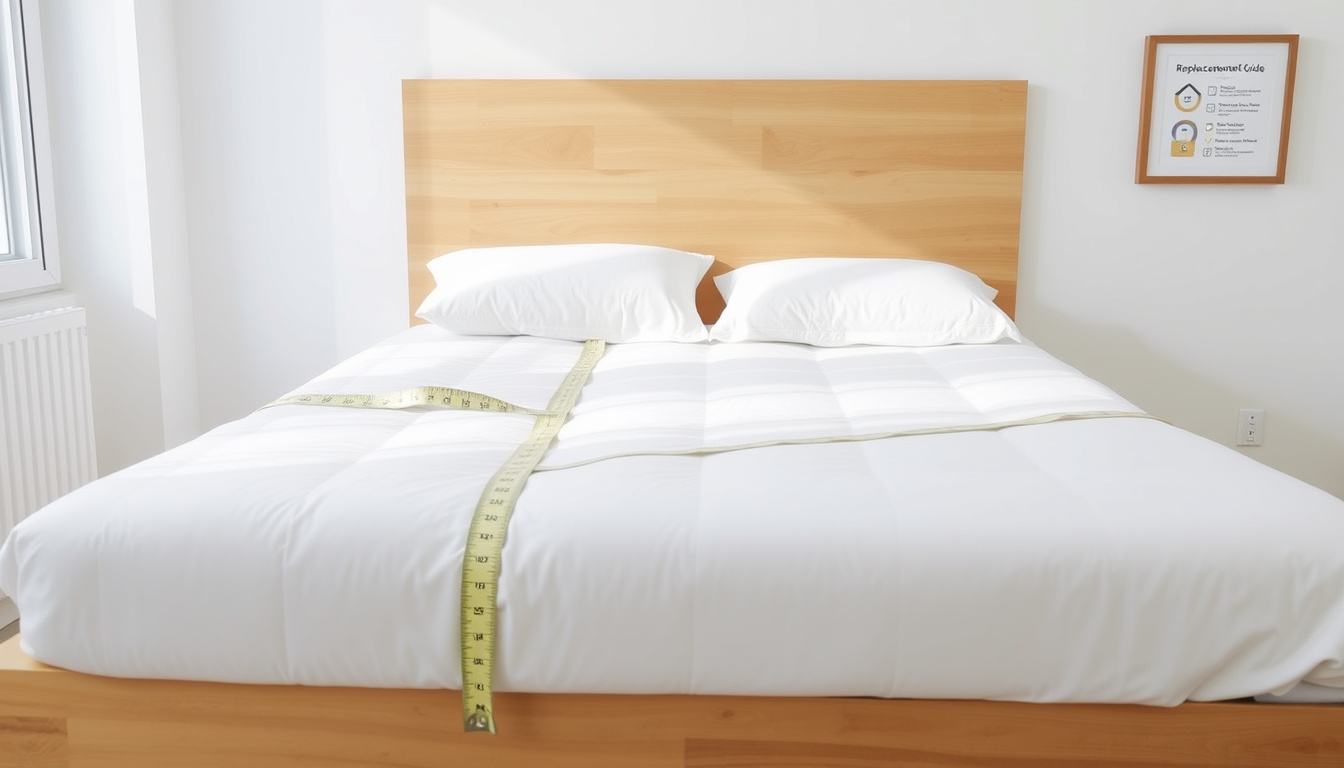
Anyone who has ever tried to match a bedsheet to an unfamiliar mattress knows that bed sizes are not as universal as they seem. In Ireland, the double bed fills a practical role—generous enough for a single sleeper, compact enough for smaller rooms, and far more common here than the queen sizes that dominate US and UK guides, and if you are wondering whether a double fits two adults or when to replace your mattress, the answers are more specific than you might expect.
Standard width: 135 cm (4 ft 6 in) ·
Standard length: 190 cm (6 ft 3 in) ·
Replacement cycle: Every 7–10 years ·
Typical cost (frame + mattress): €300–€1,200
Quick snapshot
- Irish double bed: 135 × 190 cm (Caseys Furniture, Irish retailer)
- Queen is larger but rare in Ireland (Dreams Ireland, bed specialist)
- Mattress lifespan: 7–10 years (DFI Beds, Irish manufacturer)
- Exact comfort level for two adults depends on individual preferences and bed dimensions
- Optimal replacement frequency varies by mattress type, usage, and build quality
- Bed frame lifespan (15–20 years) lacks consensus data from Irish retailers
- Mattress replacement recommended every 7–10 years (Caseys Furniture)
- Measure your existing frame before buying a new mattress (IKEA Ireland, furniture retailer)
- Check room dimensions, including access for delivery (IKEA Ireland, furniture retailer)
The table below summarises the key specifications for an Irish double bed.
| Specification | Value |
|---|---|
| Standard width | 135 cm (4 ft 6 in) |
| Standard length | 190 cm (6 ft 3 in) |
| Common European size | 140 × 200 cm |
| Small double (Ireland) | 120 × 190 cm |
| King size (Ireland) | 150 × 200 cm |
| Queen size (Ireland, uncommon) | 152 × 200 cm (approx) |
| Mattress weight capacity (per side) | Up to 250–300 kg, varies by design |
| Recommended mattress replacement | Every 7–10 years |
What is a double bed size?
- Standard double bed in Ireland: 135 cm wide × 190 cm long (IKEA Ireland, furniture retailer)
- Same size in imperial: 4 ft 6 in × 6 ft 3 in
- European alternative: 140 × 200 cm, slightly longer
What are the exact dimensions in centimetres and inches?
The Irish double bed measures 135 cm by 190 cm, or 4 feet 6 inches wide and 6 feet 3 inches long. This is consistent across major Irish retailers. Dreams Ireland, bed specialist, lists the same dimensions, as does DFI Beds, Irish manufacturer, which calls the double the most popular bed size in the country. The surface area works out to roughly 25,650 cm²—enough for one adult to stretch out, or two to sleep close.
Is 140x200cm a double bed?
In many European countries, a 140 × 200 cm mattress is labelled a double, but in Ireland and the UK it sits between a small double (120 × 190 cm) and a standard double (135 × 190 cm). Some Irish retailers occasionally stock 140 × 200 cm models, usually marketed as European doubles or continental doubles. If you are buying sheets, check the exact measurement rather than relying on the label—fitted sheets for 135 × 190 cm will not fit a 140 × 200 cm mattress properly.
The implication: when shopping for a mattress in Ireland, always confirm the exact centimetre dimensions rather than relying on size labels.
Is double the same as queen?
- No—queen is significantly larger than double
- Queen beds are rare in Ireland (Discovering Ireland Vacations, travel guide)
- US “Full” corresponds to Irish double; US “Queen” corresponds to Irish king (Discovering Ireland Vacations)
What is bigger, a double or a queen?
A queen bed is larger than a double in both width and length. In Ireland, queen-size mattresses measure approximately 152 × 200 cm (5 ft 0 in × 6 ft 8 in), while a standard double is 135 × 190 cm. That extra 17 cm in width and 10 cm in length translates to roughly 20% more sleeping surface. However, Dreams Ireland notes that queen is not a standard size in Ireland—most Irish shoppers choose between double, king (150 × 200 cm), and super king (180 × 200 cm).
What are the dimensions of a queen bed?
Queen beds sold in Ireland typically measure 152 cm by 200 cm, though availability is limited. Dreams Ireland lists king at 150 × 200 cm and super king at 180 × 200 cm, skipping a separate queen category entirely. If you see “queen” on an Irish product page, it is often an import or a marketing term—double-check the exact centimetre dimensions. The Discovering Ireland Vacations guide maps the US “Full” to the Irish double and the US “Queen” to the Irish king, which clarifies the naming mismatch across markets.
Calling a mattress “queen” in Ireland can confuse buyers who expect US dimensions. The safest move: ignore the label and read the centimetre tag. An Irish king (150 × 200 cm) is actually 2 cm narrower than an Irish queen (152 × 200 cm)—the opposite of what US shoppers expect.
Can two adults sleep in a double bed?
- Two adults fit, but each person gets roughly 67.5 cm of width—less than a standard single mattress
- Best suited for single sleepers, couples who sleep close, or guest rooms
- Taller adults may find the 190 cm length restrictive
Is a double bed for 2 people?
A double bed can technically sleep two adults, but comfort depends on body size, sleeping position, and how much each person moves at night. Each sleeper gets about 67.5 cm of personal width—narrower than a standard single (90 cm). IKEA Ireland categorises the double as suitable for one person or two who do not mind close contact. For many couples, a king (150 × 200 cm) adds 15 cm of width per person and makes a noticeable difference.
How much space does each person have?
At 135 cm total width, splitting the double bed evenly gives 67.5 cm per person—about the width of a cot mattress. For reference, a standard single bed is 90 cm wide. The length of 190 cm (6 ft 3 in) is also a limiting factor if either partner is over 185 cm tall. DFI Beds advises buyers to measure the person who will sleep on the bed lying flat, then add 10–15 cm for comfort.
Double beds save floor space in smaller Irish bedrooms, but couples trading up to a king gain roughly 30% more surface area. If your room can fit a 150 × 200 cm frame, the upgrade is usually worth the extra €200–€400.
What this means: for couples, the double bed is a compromise that works best when both partners are small or sleep still.
How often should you replace your bed?
- Mattress: every 7–10 years (Caseys Furniture)
- Bed frame: 15–20 years, depending on material and build
- A 20-year-old mattress is past its safe usable life
What are signs that you need a new mattress?
Visible sagging, lumps, and indentations are clear physical signs that a mattress has worn out. If the springs creak or you can feel the coils through the padding, the support structure has degraded. DFI Beds recommends checking for permanent body impressions deeper than 2–3 cm. Health signals include waking up with stiffness or back pain that fades during the day, increased allergy symptoms (dust mites accumulate over time), and noticeable dust or odour when stripping the bedding.
Is a 20 year old mattress too old?
Yes, a 20-year-old mattress is well past any reasonable replacement window. Even if it looks intact, the internal materials—foam, springs, padding—have degraded. Dust mites, skin cells, and bacteria build up inside the mattress over two decades, regardless of how clean the sheets are kept. DFI Beds notes that a mattress loses up to 75% of its original support after 10 years of regular use. A 20-year-old mattress provides negligible spinal support and may contribute to chronic back pain or allergy flare-ups.
The average mattress doubles in weight over 10 years due to trapped dead skin, dust mites, and moisture. A 20-year-old mattress is less a bed than a hygiene liability. If yours is from the early 2000s, replacement should be a priority.
The catch: even if a mattress looks fine, the internal support structure has decayed significantly after a decade.
What are signs that you need a new mattress?
- Visible sagging or permanent indentations deeper than 2–3 cm
- Lumpy or uneven surface when lying down
- Audible spring noise or feeling coils through fabric
- Waking up with back pain or stiffness that resolves during the day
- Increased allergy symptoms (sneezing, congestion) in bed
What specific physical signs indicate wear?
Place a straightedge across the mattress surface—if you see a gap of more than 2–3 cm at the centre, the mattress has sagged. Lumps indicate that the padding material has shifted or clumped. Dreams Ireland suggests testing the mattress by pressing a hand into each zone; if the handprint lingers for more than 10 seconds after lifting, the foam has lost resilience. For pocket-spring models, listen for individual springs twanging when you roll over—that signals broken or tired coils.
Are there health signs such as increased allergies or back pain?
Yes. A mattress that no longer supports the spine’s natural curve can cause lower back pain, hip pain, and morning stiffness that fades after you get up. BedInABox, mattress manufacturer, notes that older mattresses accumulate dust mites, pet dander, and mould spores, which can aggravate asthma or allergic rhinitis. If you wake up congested most mornings or your partner’s allergies have worsened since moving in, the mattress may be the culprit. Replacing it every 7–10 years addresses both comfort and hygiene.
The following comparison table highlights the main size differences across markets.
| Size | Width | Length | Surface area | Common in Ireland? |
|---|---|---|---|---|
| Double | 135 cm (4 ft 6 in) | 190 cm (6 ft 3 in) | 25,650 cm² | Yes—most popular size |
| Queen (Ireland) | 152 cm (5 ft 0 in) | 200 cm (6 ft 8 in) | 30,400 cm² | Rare—not standard in market |
| King (Ireland) | 150 cm (4 ft 11 in) | 200 cm (6 ft 8 in) | 30,000 cm² | Yes—common alternative |
| US Full | 137 cm (54 in) | 191 cm (75 in) | 26,167 cm² | Comparable to Irish double |
| US Queen | 152 cm (60 in) | 203 cm (80 in) | 30,856 cm² | Not standard in Ireland |
| Specification | Irish double | Notes |
|---|---|---|
| Width | 135 cm | 4 ft 6 in |
| Length | 190 cm | 6 ft 3 in |
| Area | 25,650 cm² | ~2.57 m² |
| Weight capacity (per side) | 250–300 kg | Varies by mattress construction |
| Recommended mattress depth | 15–30 cm | |
| Mattress lifespan | 7–10 years | |
| Frame lifespan | 15–20 years | Depends on material and use |
| Fitted sheet size | 135 × 190 cm | Check depth pocket for thick mattresses |
| Typical mattress price (Ireland) | €150–€400 | |
| Typical frame price (Ireland) | €150–€800 |
Confirmed facts
- Double bed dimensions in Ireland are 135 × 190 cm (IKEA Ireland)
- Queen is larger than double (Dreams Ireland)
- Mattress replacement recommended every 7–10 years (Caseys Furniture)
- US Full maps to Irish double (Discovering Ireland Vacations)
What’s unclear
- Exact comfort level for two adults depends on individual preferences and body sizes
- Optimal replacement frequency varies by mattress type (memory foam vs spring vs hybrid) and usage intensity
- Availability of 140 × 200 cm “European double” varies by retailer and region in Ireland
“A double bed gives one person generous space. For two, you’re looking at a noticeably snug fit—each side is only 67.5 cm wide, which is less than a standard single.”
— IKEA Ireland, size guide
“Always measure your existing bed frame before buying a new mattress. Sizes can vary slightly between manufacturers, and a new mattress that does not fit the frame properly will not give you the comfort you paid for.”
— Caseys Furniture, advice to customers
“The Irish market does not use queen sizing as a standard category. What US buyers call a queen, Irish shoppers call a king. That difference causes a lot of confusion for online orders.”
— Dreams Ireland, market observations
The upshot for Irish buyers is straightforward: a double bed suits single sleepers and compact rooms, but couples should seriously consider a king if space permits. Two adults sharing a double each get less sleeping width than a single mattress, and the 190 cm length can leave taller people with dangling feet. On the other hand, if your bedroom is under 10 m², a double is often the largest size that leaves room for bedside furniture and movement. For shoppers in Ireland, the decision comes down to a trade-off—more surface area versus floor space. Measure both the room and the heaviest sleeper, then pick the largest size that fits without sacrificing circulation space. That is the only rule that reliably leads to a good night’s sleep.
För att undvika förvirring kring IKEA-standardmått i Irland rekommenderar vi att alltid mäta sängramen före köp.
Frequently asked questions
What is the difference between a double and a twin bed?
A twin bed (also called a single in Ireland) is 90 cm wide, compared to a double’s 135 cm. Twin beds are designed for one person, while a double can sleep one person generously or two adults in close quarters.
Can a double bed fit in a small room?
Yes. A double bed frame typically occupies about 2.6 m² of floor space (135 cm × 190 cm plus frame border). It fits comfortably in a room of 8–10 m², provided you allow at least 50 cm of circulation space on either side.
What size sheets do I need for a double bed?
Irish double bed sheets are marked 135 × 190 cm. Fitted sheets also require a depth measurement, typically 20–30 cm. European double sheets marked 140 × 200 cm will not fit properly. Look for the exact centimetre label.
Are double beds common in Ireland?
Yes. DFI Beds describes the double as the most popular bed size in Ireland. It outsells small double, queen, and super king in most Irish retail channels, though king-size sales have risen steadily in the past decade.
How much does a double bed cost on average?
A complete double bed (frame + mattress) in Ireland typically ranges from €300 to €1,200. Mattresses alone cost €150–€400, and frames €150–€800 depending on materials, headboard style, and storage features.
What is the best mattress firmness for a double bed?
Medium-firm (rated 6–7 out of 10) is the most common recommendation for double bed mattresses, as it supports both back and side sleepers. Lighter individuals may prefer medium, while heavier sleepers often need firm. Sleeping position also plays a role.
Can I use a double bed for a child’s room?
Yes. A double bed works well for a teenager’s room or a child’s room that doubles as a guest room. The extra width (compared to a single) also allows a parent to sit or lie beside the child for bedtime reading or comfort.
Related stories



Ryan Hughes is Senior Reporter at Australia Current, covering breaking stories and explainers.