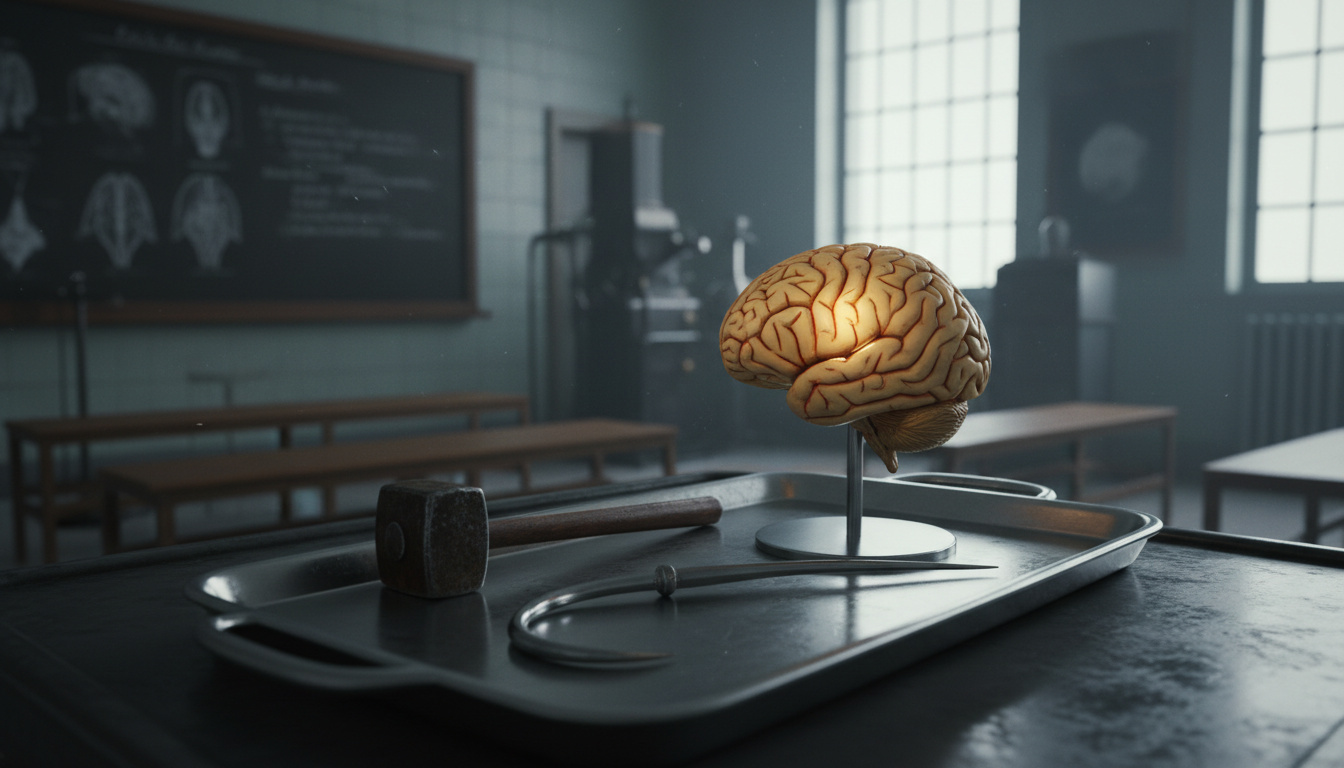

The prefrontal transorbital lobotomy stands as one of the most controversial medical procedures in modern history. Developed in the mid-20th century as a supposed remedy for severe mental illness, the technique involved inserting an ice pick-like instrument through the eye socket to sever neural connections within the brain. Practitioners claimed it could calm agitated patients suffering from schizophrenia and depression, offering relief when asylums faced severe overcrowding and limited treatment options.
Portuguese neurologist António Egas Moniz pioneered the foundational technique in 1935, later earning a Nobel Prize for his work. American neurologist Walter Freeman subsequently popularized a streamlined transorbital version using an orbitoclast, performing thousands of procedures across the United States from the late 1930s through the 1950s. Despite initial enthusiasm, the operation fell into disrepute amid mounting evidence of devastating side effects and the emergence of effective antipsychotic medications.
What Is a Lobotomy?
Key insights about the procedure:
- Intended to treat mental illness by calming patients and reducing agitation
- Often caused permanent personality changes, apathy, and emotional blunting
- The ice pick method enabled outpatient procedures without sterile conditions
- Popularity declined sharply with the introduction of antipsychotics like chlorpromazine in the 1950s
- Raised profound ethics questions regarding informed consent and medical efficacy
| Fact | Details |
|---|---|
| Primary Types | Prefrontal lobotomy, Transorbital lobotomy |
| Duration | 10–20 minutes for transorbital version |
| Mortality Rate | 1–4% |
| Nobel Prize | António Egas Moniz, 1949 |
| First Performed | 1935 (Portugal) |
| US Introduction | 1936 (Freeman and Watts) |
| Peak Procedures | ~60,000 in US and Europe (1946–1956) |
| Discontinuation | 1950s–1960s |
The procedure targeted the white matter tracts connecting the prefrontal cortex to the thalamus, areas believed to influence emotional regulation and behavior. Medical literature documents that Moniz developed the technique based on earlier observations of personality changes in patients with frontal lobe damage. By disrupting these neural pathways, practitioners aimed to reduce symptoms of agitated depression and schizophrenia.
How Was a Lobotomy Performed?
The procedure evolved from the prefrontal leucotomy developed by Moniz and Lima in 1935. Initially, this involved drilling holes into the skull and injecting alcohol or using a leucotome to disrupt white matter tracts connecting the prefrontal cortex to the thalamus. The operation required hospitalization and carried significant risks of infection and complications.
The Transorbital Method
Walter Freeman revolutionized the technique in 1945 by introducing the transorbital approach. Using an instrument resembling an ice pick called an orbitoclast, Freeman would insert the device approximately 7 centimeters through the thin bone of the eye socket, positioning it to sever frontal lobe-thalamic tracts. Freeman adjusted the depth and angle based on the diagnosis: sweeping 15 degrees laterally for affective disorders versus posterior placement for schizophrenia.
Freeman frequently performed the transorbital procedure in under ten minutes without sterile conditions, anesthesia, or proper surgical facilities. This crude approach, often conducted in office settings or while traveling “on the road,” exposed patients to severe risks including infections, seizures, and fatal hemorrhaging.
Prefrontal versus Transorbital
While the original prefrontal lobotomy required opening the skull, the transorbital variant avoided this entirely. The latter technique allowed Freeman to perform thousands of operations rapidly, eventually conducting over 4,000 procedures until 1967. The speed and accessibility paradoxically increased its usage despite higher complication rates compared to the original surgical method.
What Are the Effects of a Lobotomy?
Patients typically emerged from the procedure with reduced agitation and calmer demeanors, which asylum administrators often interpreted as success. However, results remained inconsistent: some individuals showed short-term improvement, while others experienced no change or relapsed into previous behavioral patterns. The operation never provided a long-term cure for underlying conditions like schizophrenia or depression.
Documented Side Effects
The physiological and psychological consequences proved devastating for many recipients. Common adverse effects included profound apathy, passivity, and emotional blunting. Patients frequently lost the ability to concentrate, showed reduced initiative, and experienced a flattened emotional depth previously essential to their personalities. Physical complications ranged from seizures and infections to death, with early practitioner Gottlieb Burckhardt recording one fatality and one suicide among his initial cases.
Success Rates and Long-term Outcomes
Contemporary assessments reveal mixed outcomes at best. While the procedure rendered difficult patients more manageable within overcrowded institutions, neurosurgeons eventually criticized the crude methodology and unpredictable results. The lack of standardized measurement meant “success” often merely indicated reduced behavioral disruption rather than genuine therapeutic recovery.
Why Was Lobotomy Used and Then Abandoned?
The procedure gained traction during a period of desperation within psychiatric medicine. Facing severe institutional overcrowding and lacking effective pharmacological treatments, physicians viewed psychosurgery as a last resort for managing violent or uncontrollable patients. The technique peaked between 1946 and 1956, with approximately 60,000 procedures performed across the United States and Europe.
Medical ethicists condemned the practice for its irreversibility and frequent lack of informed consent. Critics noted that Freeman promoted the procedure through popular media despite mounting evidence of risks, while his partner James Watts eventually distanced himself due to concerns over non-sterile techniques. The operation prioritized institutional control over patient welfare, violating the fundamental medical principle of “do no harm.”
The abandonment accelerated rapidly during the late 1950s following the introduction of chlorpromazine and other antipsychotic medications. These chemical alternatives offered safer, reversible management of symptoms, rendering the destructive surgery obsolete. By the 1960s, professional medical societies had effectively restricted the practice, though it never faced formal legislative banning in the United States.
The shift represented a fundamental paradigm change in psychiatry. Rather than permanently altering brain structure, clinicians could now modulate neurochemical pathways. This approach preserved patient autonomy and cognitive function while addressing the root symptoms that had previously justified lobotomy’s risks.
What Are Famous Examples of Lobotomies?
Verified historical records identifying specific famous patients remain limited within available source material. While broader historical knowledge references cases such as Rosemary Kennedy—sister to President John F. Kennedy, who underwent the procedure in 1941—direct sourcing for individual patient histories appears sparse in current medical archives. Most documented cases involve anonymous institutional residents rather than public figures.
Walter Freeman performed over 4,000 operations between 1936 and 1967, traveling across the United States in a vehicle he called the “lobotomobile.” This itinerant practice brought the surgery to state hospitals and asylums nationwide, affecting thousands of families whose stories remain largely untold in formal medical literature.
Is Lobotomy Still Performed Today?
Psychosurgical lobotomy as practiced in the mid-20th century no longer occurs in modern medicine. Freeman performed his final procedure in 1967, stopping after a patient died during the operation in 1960. While never formally banned by federal legislation in the United States, the practice became heavily restricted through professional medical standards and institutional review boards.
Contemporary regulations render the procedure illegal or permissible only under strict consent protocols in most jurisdictions. Medical ethics boards universally condemn the crude, non-sterile methods employed during the peak era. Modern psychiatry has completely abandoned the irreversible severing of frontal lobe connections as a treatment modality.
When Did Lobotomy Become Popular?
The technique emerged from decades of neurological experimentation, gaining widespread adoption during specific historical circumstances.
- : Swiss psychiatrist Gottlieb Burckhardt performs early cortex resections for aggressive behavior, predating modern techniques.
- : António Egas Moniz and Almeida Lima conduct the first prefrontal leucotomies in Portugal using alcohol injections and a leucotome.
- : Walter Freeman and James Watts perform the first U.S. lobotomy; Moniz presents his initial 20 cases to the medical community.
- : Freeman debuts the transorbital ice pick method, dramatically reducing procedure time and technical requirements.
- : Peak popularity period, with approximately 60,000 procedures performed across the United States and Europe.
- : Moniz receives the Nobel Prize in Physiology or Medicine for his discovery of the therapeutic value of prefrontal leucotomy.
- : Introduction of chlorpromazine marks the beginning of effective antipsychotic pharmacotherapy.
- : Freeman performs his final lobotomy, effectively ending the era of widespread psychosurgery.
Did Lobotomy Work?
Evaluating the procedure’s efficacy requires separating documented physiological effects from therapeutic success.
Established Information
- Surgical severing of frontal lobe-thalamic tracts consistently altered patient behavior
- High complication rates including seizures, infections, and mortality (1–4%) are well-documented
- The practice has been completely replaced by pharmacotherapy and psychotherapy
- Moniz received the 1949 Nobel Prize, indicating temporary medical consensus on value
Uncertain or Debated
- Exact long-term success rates vary significantly across different studies and institutions
- Individual patient outcomes remain unpredictable, with no reliable preoperative indicators
- The degree of informed consent obtained from patients and families remains historically unclear
What Was the Historical Context of Lobotomy?
The rise of lobotomy occurred within a landscape of institutional desperation. Early 20th-century psychiatric facilities faced severe overcrowding, with thousands of patients suffering from schizophrenia, depression, and other conditions for which no effective treatments existed. Historical portrayals in media like the Poor Things Movie – Plot, Cast and Ending Explained occasionally reference the era’s medical barbarism, though the procedure itself rarely appears in contemporary entertainment.
The ethical framework surrounding the practice reflected utilitarian calculations that prioritized institutional order over individual patient welfare. Practitioners like Freeman viewed the operation as a necessary evil, arguing that reducing agitation justified the neurological damage inflicted. This philosophy directly contradicted the Hippocratic obligation to “do no harm,” setting the stage for later bioethical reforms that emphasized patient autonomy and non-maleficence.
The subsequent shift toward pharmacotherapy represented more than technological progress—it signified a fundamental reconceptualization of mental illness as treatable through biochemical intervention rather than surgical destruction. While seemingly unrelated, the development of precise medical interventions like those detailed in How to Stop Hiccups – Proven Remedies for Adults and Babies illustrates the broader trend toward targeted, reversible treatments that characterized post-lobotomy medicine.
What Did the Pioneers Say About Lobotomy?
Contemporary statements from the procedure’s originators reveal the medical mindset that justified such radical intervention.
“Operations on the frontal lobes… modify the manifestations of certain mental disturbances and particularly of agitated depression.”
— António Egas Moniz, Nobel Prize acceptance, 1949 (Nobel Prize archives)
“Lobotomy gets them home.”
— Walter Freeman, 1950s (attributed in medical histories)
Freeman’s succinct declaration encapsulated the institutional priorities of the era, emphasizing discharge over recovery. These quotations now serve as historical artifacts documenting a period when psychiatric medicine embraced irreversible surgical intervention.
What Is the Legacy of Lobotomy Today?
The lobotomy era serves as a cautionary benchmark in medical ethics, illustrating the dangers of prioritizing convenience over patient welfare. While the specific procedure has vanished, its shadow informs contemporary regulations governing psychosurgery, ensuring that modern interventions like deep brain stimulation operate under strict ethical review, informed consent protocols, and reversible parameters. The historical trajectory from ice picks to precision medicine underscores psychiatry’s ongoing evolution toward humane, evidence-based care.
Did lobotomy work?
Results were mixed. Some patients became calmer and more manageable, but many experienced severe personality changes, apathy, and intellectual impairment without cure of underlying illness.
What is the success rate of lobotomy?
Historical records indicate inconsistent outcomes. While some asylums reported reduced agitation, the procedure carried a 1–4% mortality rate and high incidence of severe side effects like seizures and infections.
Are there modern lobotomies?
No. The procedure is obsolete. Modern psychiatry uses pharmacotherapy, psychotherapy, and rarely, targeted psychosurgeries like deep brain stimulation for refractory cases, which differ fundamentally from lobotomy.
When was lobotomy banned?
The United States never formally banned lobotomy federally, but professional medical restrictions and antipsychotic alternatives effectively ended the practice by the 1960s. Most jurisdictions now prohibit or heavily regulate it.
Who invented the lobotomy?
Portuguese neurologist António Egas Moniz pioneered the prefrontal leucotomy in 1935. Walter Freeman later adapted and popularized the transorbital ice pick method in the United States.
How was the ice pick lobotomy performed?
Walter Freeman inserted an orbitoclast resembling an ice pick through the eye socket, hammering it through thin bone to sever frontal lobe connections, often without anesthesia or sterile conditions.
Is lobotomy illegal today?
While not universally banned by statute, the procedure is effectively illegal in most jurisdictions due to medical ethics regulations, lack of practitioner approval, and availability of superior alternatives.
Related stories




Liam O'Brien covers Australian politics and public affairs for Australia Current.