
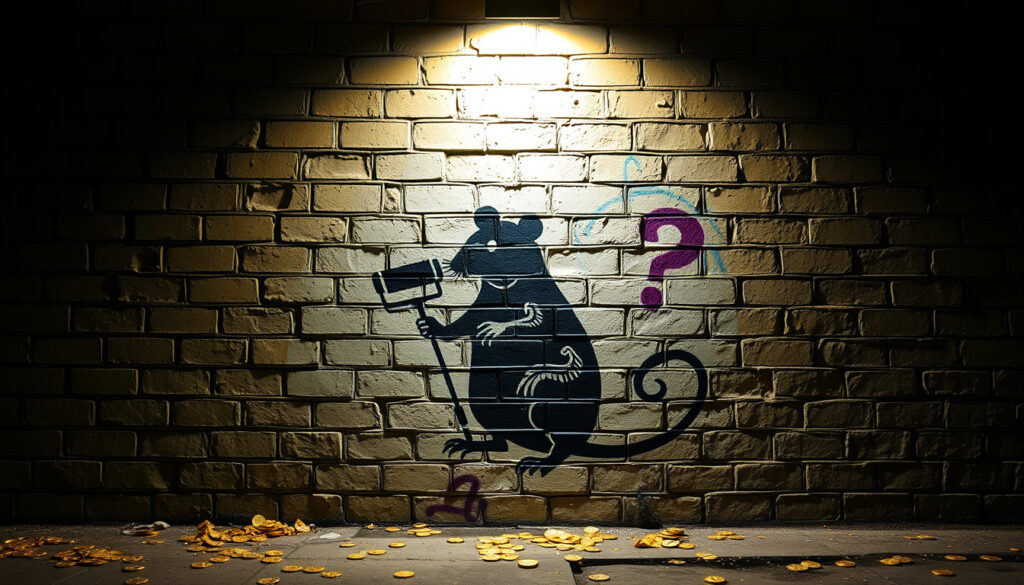
One of art’s most enduring mysteries may finally be cracking. A March 2026 Reuters investigation reportedly surfaced records identifying Banksy as Robin Gunningham — who allegedly changed his name to David Jones — yet Banksy’s representatives have declined to comment on any of it.
Base: England · Public Identity: Pseudonymous · Suspected Name: Robin Gunningham · Alternative Name: David Jones · Millionaire Status: Yes, via art sales
Quick snapshot
- Exact birthdate — year estimated only (Fortune)
- Whether name change was purely for anonymity (Fortune)
- Whether he acts alone or with a crew (Banksy Tried to Warn You)
- 2008: Daily Mail publishes compelling Gunningham evidence (Fortune)
- 2016: Associated Press covers Gunningham link investigation (Fortune)
- Mar 2026: Reuters reveals name change to David Jones (Fortune)
- Art market watching whether unmasking changes auction values (Fortune)
- Banksy spokesperson declined interview for Reuters piece (Fortune)
The following table summarises the key facts that have emerged from investigations.
| Fact | Detail |
|---|---|
| Known As | Banksy |
| Profession | Street artist, activist, director |
| Origin | England |
| Identity Status | Unconfirmed publicly |
| Key Suspect | Robin Gunningham |
| Alternative Name | David Jones |
| Est. Birth Year | Around 1972 |
| UK Arrest | September 17, 2000 |
| Art Market Ranking | Among wealthiest street artists |
What is Banksy’s real identity?
The most persistent question about Banksy is also the one that refuses to stay answered. A Reuters investigation published in March 2026 reportedly surfaced documents identifying Banksy as Robin Gunningham, a Bristol native born around 1972 who allegedly legally changed his name to David Jones after 2008 (Fortune). David Jones is the second most common name in Britain — a choice that would make the alias nearly untraceable.
Robin Gunningham theory
The Gunningham connection traces back further than most realise. The Daily Mail reported compelling evidence linking him to Banksy in 2008, and Associated Press covered detective work expanding that link in 2016 (Fortune). A handwritten confession reportedly filed in Manhattan court records places Gunningham at a Marc Jacobs billboard defacement on September 17, 2000 — he described painting eyeshadow, a new mouth, and a speech bubble on a billboard model (Fortune). Financial records and travel movements allegedly match up with Banksy’s known whereabouts, including a December 2022 trip to Ukraine with a known associate just before seven murals appeared there — all of which Banksy confirmed creating (Fortune).
David Jones reports
The Reuters investigation reportedly went beyond Gunningham by unearthing a legal name change to David Jones, a move that could serve as both a fresh alias and a form of identity protection (Fortune). Some speculation holds that Banksy himself may have orchestrated the unmasking — turning a potential exposure into controlled narrative. Banksy’s lawyer did not respond to identity queries, and the artist’s spokesperson declined to participate in the reporting (Fortune).
Other speculations
Alternative theories have never fully quieted. The most durable alternative holds that Banksy is Robert Del Naja — known as 3D — the frontman of Massive Attack, based on matching visual motifs and Del Naja’s own Bristol origins. Banksy reportedly addressed this head-on in a quote: “No, I copied 3D from Massive Attack. He can actually draw” (Banksy Tried to Warn You). Others contend Banksy operates as a collective rather than a single individual, a theory critics note lacks specific supporting evidence (Banksy Tried to Warn You).
Who is Banksy and why is he so famous?
Whatever name sits behind the pseudonym, Banksy has built a career that few in contemporary art can match in cultural reach. The artist emerged from Bristol’s postindustrial street art scene in the late 1990s and early 2000s, eventually expanding into stenciled murals, installations, and public pranks that blend satire, protest, and dark humour (Fortune).
Street artist background
Banksy began tagging as Slick with the Drybreds crew around the year 2000, alongside artists known as Ko and Tess (Banksy Tried to Warn You). By that same year, the Banksy name was circulating in street art circles, though the identity behind it remained a deliberate blank. A 2006 exhibition reportedly offered the first public glimpse behind the mask — or at least the closest thing to it that had surfaced at that point (Banksy Tried to Warn You).
Political activism
Banksy’s work consistently takes aim at war, capitalism, surveillance, and authority. His stunts — from placing a in the British Museum to deploying a mobile “Dismaland” theme park at a shuttered seaside resort — have made him both celebrated and controversial. The anonymity is not incidental to this work; it is structurally part of it. A named artist issuing a political statement carries different weight than an unsigned image appearing overnight on a wall.
Film director role
Beyond street art, Banksy directed the 2010 film “Exit Through the Gift Shop,” which won the BAFTA for Best Documentary Feature. The film blurred lines between documentary and performance, and between Banksy the director and Thierry Guetta the subject. It reinforced the brand: art that interrogates itself, and an artist who treats visibility as a punchline.
How does Banksy not get caught?
The question of how an artist who works outdoors at night, sometimes in high-profile locations, avoids both arrest and clear identification has its own mythology.
Anonymity tactics
Multiple reports describe consistent operational habits: working at night, using stencils to cut down on time, avoiding repeated locations, and keeping a legal and public life strictly separate from the artistic one. Simon Hattenstone’s 2003 description — white, 28, scruffy, wearing a silver tooth, chain, and earring — remains one of the few on-record physical accounts (Banksy Tried to Warn You). Journalists have reportedly used location clues, travel records, and financial traces to build profiles, but the artist stays one step ahead by design.
Avoiding detection at sites
A 2025 Banksy print appeared under a surveillance camera at the Royal Courts of Justice in England — either an inside joke or proof that Banksy is no longer trying to hide as much as he once did (Banksy Tried to Warn You). The Ukraine murals further complicated the picture: the artist confirmed them publicly, essentially owning seven new works while still keeping his face out of frame. The pattern suggests that as Banksy’s market value climbs, the gap between “mysterious” and “exposed” narrows with every investigation.
For art market watchers, the Reuters unmasking raises a concrete question: does a named artist fetch higher prices or lower ones? Market history offers conflicting signals. Some collectors prize the anonymity premium; others will pay anything for provenance. The next major Banksy auction will test which camp is larger.
Is Banksy a millionaire?
By any measure of the auction market, Banksy’s work has crossed into genuinely rare financial territory.
Net worth estimates
Banksy’s pieces routinely sell for seven figures. “Girl with Balloon” sold for £1.4 million at Sotheby’s in 2018 — then famously shredded itself moments after the hammer fell, adding an entirely new chapter to its value story. “Devolved Parliament” sold for £2.2 million in 2019. Print editions that once sold for hundreds now command tens of thousands. Art market analysts consistently rank Banksy among the wealthiest street artists globally (Wisconsin’s Morning News).
Wealthiest street artists
Banksy sits near the top of virtually every list comparing street artists by auction totals. The self-shredding stunt alone generated more column inches and auction buzz than most artists earn in a decade of conventional shows. Unlike peers who rely on gallery representation and consistent output, Banksy controls scarcity through deliberate drip of work that keeps demand acute.
Reuters found David Jones — the UK’s second most common name — on legal documents allegedly tied to Robin Gunningham post-2008. If the alias was chosen deliberately to obscure rather than just rename, it suggests a level of strategic planning that few would bother with. The choice of name may be the most revealing clue of all.
What this means: the anonymity that fuels curiosity also protects a market premium. Once an identity is confirmed — and confirmed publicly — the art world will have to reckon with whether unmasking adds or subtracts from that value.
Is Banksy really Anonymous?
Anonymous and pseudonymous are not quite the same thing. Banksy does not deny being a person — he just refuses to name which one.
Unmasking claims
The Reuters report represents the most direct public attempt to pin a name to the brand. It did not produce a photograph of the artist at his easel or a notarised confession. It produced documents — arrest records, financial traces, travel patterns — that investigative journalists argued add up to proof (Fortune). Critics of the Reuters findings say the case may not be conclusive, noting that circumstantial evidence and actual identity are not the same thing (10 News+).
Ongoing mystery
Some observers argue the constant cycle of investigation and denial has become its own brand asset. Each unmasking story generates fresh coverage, each denial reinforces the mystique, and the artist retains the ability to respond on his own terms — or not at all. The 2022 Ukraine murals, which Banksy confirmed directly, showed an artist willing to engage with the world while still declining to show his face.
The paradox: the more the world insists on knowing who Banksy is, the more valuable the act of not telling becomes. The unmasking — whenever it finally lands — may be the one thing that costs Banksy the mystery that built the brand.
The evidence: confirmed versus rumored
The Banksy identity question has produced more theories than almost any other in contemporary art. Separating what is documented from what is speculated matters for anyone following the story seriously.
Confirmed
- Reuters March 2026 investigation identified Robin Gunningham as primary suspect (Fortune)
- Gunningham was arrested September 17, 2000, for billboard defacement in Manhattan (Fortune)
- A handwritten confession reportedly filed in court documents describes the act in detail (Fortune)
- Banksy publicly confirmed seven Ukraine murals in 2022, and travel records reportedly place David Jones in the region beforehand (Fortune)
- Banksy’s representatives declined to participate in Reuters reporting (Fortune)
Unconfirmed
- Whether the name change to David Jones was legally filed and for anonymity purposes specifically
- Whether Gunningham and Banksy are definitively the same person — Reuters presented evidence, not proof
- Whether the Ukraine trip was for mural production or unrelated
- The 3D from Massive Attack theory remains a persistent alternative with no confirmed link
- Whether the collective theory holds any merit — critics say it lacks supporting evidence
The evidence gap matters: while investigative journalists have assembled a compelling circumstantial case, the standard for proof in the art world and the legal system remains different from what reporters consider sufficient for publication.
Timeline: two decades of investigation
A chronology of the key moments that have punctuated the search for Banksy’s real name.
| Date | Event |
|---|---|
| Around 1972 | Robin Gunningham reportedly born in Bristol, UK |
| September 17, 2000 | Gunningham arrested in Manhattan for billboard defacement; reportedly files handwritten confession |
| 2006 | First major exhibition reportedly offers public glimpse behind Banksy’s anonymity |
| 2008 | Daily Mail publishes compelling evidence linking Gunningham to Banksy |
| 2016 | Associated Press covers detective work connecting Banksy to Gunningham; Craig Williams publishes 3D theory |
| Late 2022 | David Jones reportedly travels to Ukraine with a Banksy associate before seven murals appear |
| March 2026 | Reuters investigation surfaces name change to David Jones and new arrest records |
What people are saying
“I had been out drinking at a nightclub with friends when I decided to make a humorous adjustment to a billboard on top of the property.”
— Robin Gunningham, in a handwritten confession reportedly filed in court records
“No, I copied 3D from Massive Attack. He can actually draw.”
— Banksy, responding to 3D/Massive Attack identity theory
“Banksy is white, 28, scruffy, casual — jeans, t-shirt, a silver tooth, silver chain, and silver earring.”
— Simon Hattenstone, journalist, 2003 interview account
For art market observers, the Reuters unmasking creates an immediate question with real money attached: does knowing who Banksy is change what his work is worth? Some argue the mystery is load-bearing for the brand — comparable to revealing that Santa Claus has a real name. Others counter that provenance always increases value, and a confirmed identity would finally settle a question that has shadowed every auction catalog. The next major sale will be the most telling data point yet.
Related reading: Poor Things identity exploration
Banksy’s enigmatic art continues to mesmerize global audiences through immersive shows like the House of Banksy Leipzig exhibition, spanning graffiti to video installations on 1,500 square meters.
Frequently asked questions
Is Robin Gunningham definitively Banksy?
No public confirmation exists. The Reuters investigation in March 2026 reportedly found arrest records, financial traces, and travel data linking Robin Gunningham to Banksy, but neither Banksy nor his representatives have acknowledged the findings. The evidence is substantial by investigative standards; proof in the legal or documentary sense remains absent.
What is Banksy’s net worth?
Banksy consistently ranks among the world’s wealthiest street artists. Individual works have sold for over £2 million at major auction houses. The self-shredding “Girl with Balloon” moment added a layer of cultural value that conventional market analysis cannot easily quantify.
How old is Banksy estimated to be?
Most sources estimate a birth year around 1972, which would put the artist in their early fifties as of 2026. A 2003 interview described him as 28 at the time, consistent with that estimate.
Has Banksy ever been photographed?
No verified, widely accepted photograph of Banksy’s face has been published. The 2003 Simon Hattenstone description remains one of the most detailed on-record accounts. A spray can has been photographed but not confirmed as belonging to the artist.
Why does Banksy remain anonymous?
Anonymity is structurally integrated into the Banksy brand. It enables political critique without personal exposure, generates ongoing media interest with each unmasking story, and creates an identity premium in the auction market that a named artist would not automatically carry.
What is Banksy’s most famous work?
“Girl with Balloon” is among the best-known, famous for both its image and its 2018 self-shredding stunt. “Devolved Parliament,” showing chimpanzees in the House of Commons, sold for £2.2 million in 2019. The Dismaland installation and the Walled Off Hotel in Bethlehem are also widely cited as landmark works.
Is Banksy still active?
Banksy confirmed creating seven murals in Ukraine in 2022, directly engaging with the ongoing conflict. A 2025 print appeared at the Royal Courts of Justice in England. The artist shows no signs of slowing — and no signs of revealing his face.
Who owns Banksy artworks?
Ownership spans private collectors, museums, and councils. “Girl with Balloon” was partially destroyed mid-auction but remains partly owned by the original buyer. Several major works have been removed from public walls by property owners and sold at auction. The authenticity and provenance chain is managed through Pest Control, the artist’s authentication service.
Related stories

Rachel Bennett leads fact-checking, source verification and corrections at Australia Current.