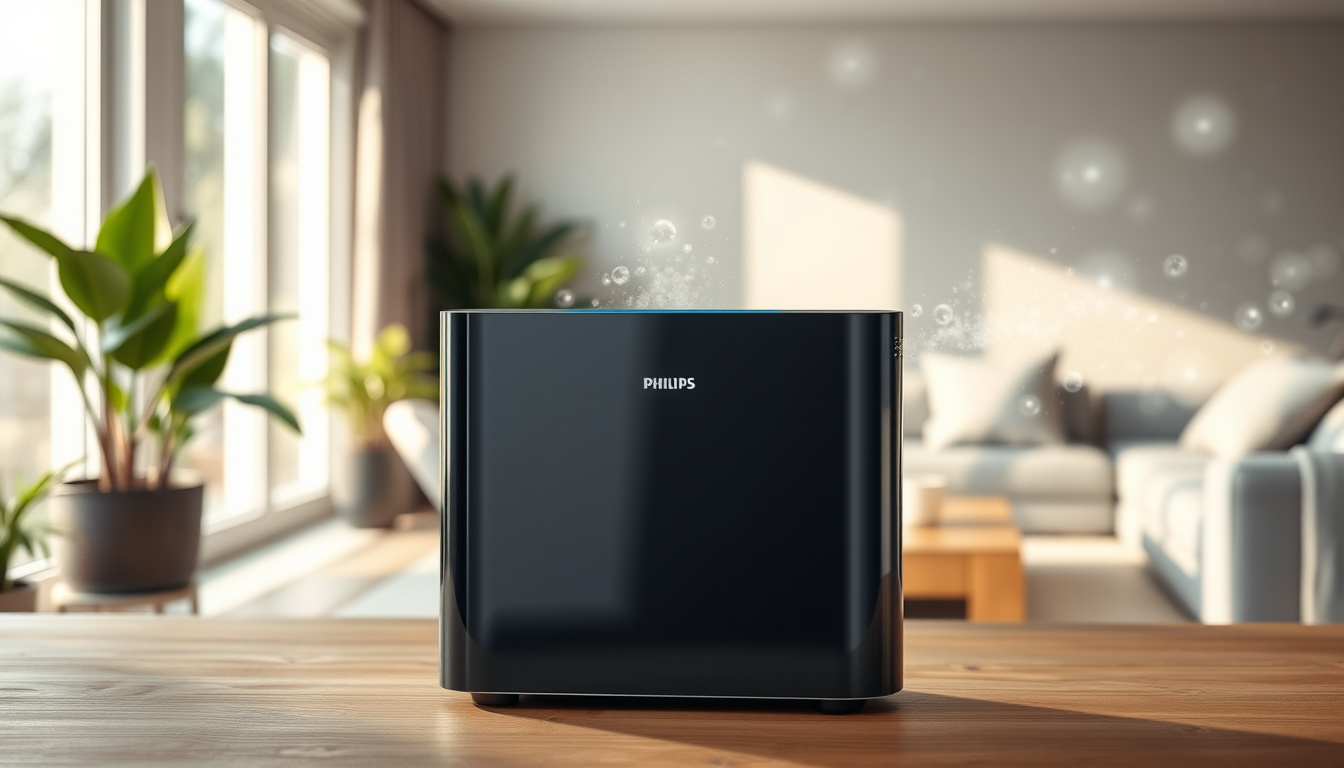
Shoppers browsing allergy forums and Irish retailer listings keep asking the same questions about the Philips 800 Series air purifier: does the CADR rating hold up in real rooms, and is the filter worth changing every year? The series has accumulated enough independent testing and buyer reviews to start separating the marketing from the measurable. Here’s what the data shows—and what still requires a closer look.
CADR: 190 m³/h · Room coverage: up to 49 m² · Filter type: HEPA & Active Carbon · App connectivity: Air+ App
Quick snapshot
- HEPA filter captures 99.5% of particles down to 0.003 microns (Philips)
- Purifies air in under 16 minutes at CADR 190 m³/h (Philips Official)
- Sleep mode operates at 35 dB (Galaxus)
- Long-term ozone emission behaviour under extended use
- Actual filter replacement cost in Irish retail stores
- Real-world room coverage versus AHAM-labelled figures
- Philips AC0820/10 released October 2019 (Galaxus)
- 800i variant still available in Ireland at €206.98 via Klarna (Klarna Ireland)
- Filter compatibility between 800 and 800i series confirmed by long-term users
- Series 8000 now listed on Philips.ie as 3-in-1 purifier, fan, and heater
The specifications below consolidate verified figures from Philips Official, Air Purifier First, and Galaxus, noting where manufacturer claims and independent test results diverge.
| Specification | Value |
|---|---|
| Clean Air Delivery Rate (CADR) | 190 m³/h |
| Maximum room size | 49 m² |
| Filter types | HEPA & Active Carbon |
| Connectivity | Air+ App |
| Particle capture | 99.5% at 0.003 microns |
| Sleep noise level | 35 dB |
| Maximum power | 56 W |
| Filter life | 12 months |
How good are Philips air purifiers?
The Philips 800 Series earns its place through measurable performance rather than brand reputation alone. Independent testing by Air Purifier First recorded a 93% improvement in air quality, reducing the Air Quality Index from 122 to 9 during controlled chamber tests. The same review documented smoke removal in 33 seconds. These figures place the 800 Series in the mid-to-upper tier of compact home purifiers.
Performance metrics
- CADR of 190 m³/h, verified across Philips Official and contract sources
- Purification cycle under 16 minutes for a standard mid-sized room (Philips Official)
- Maximum power draw of 56 W — comparable to a standard incandescent bulb
The 3-stage filtration stack combines a pre-filter, NanoProtect HEPA layer, and activated carbon stage. According to Air Purifier First, the filter life reaches 12 months before replacement is required, though the actual lifespan depends on local pollution levels and daily run time.
The implication is that buyers should treat the manufacturer’s 49 m² ceiling as the practical limit rather than the headline room-size figure, especially in rooms with open connections to other spaces.
User reviews
Verified buyer reviews on Feefo show consistent praise for quiet operation and noticeable air quality improvement. The consensus centres on small-to-medium room effectiveness rather than whole-house coverage.
For rooms up to 50 m², the 800 Series clears the air measurably fast. Buyers expecting whole-apartment coverage will notice the unit working harder and longer.
Would an air purifier help COPD?
Respiratory conditions such as COPD involve heightened sensitivity to indoor particulate matter, and the Philips 800 Series addresses this through its HEPA filtration layer. According to Consumer Reports — an organisation that has tested appliances since 1936 — air purifiers with true HEPA filters reduce airborne triggers that commonly exacerbate COPD symptoms.
Benefits for respiratory conditions
- Removes 99.5% of ultra-fine particles down to 0.003 microns, certified by the European Centre for Allergy Research Foundation (Philips Official)
- Continuous operation mode maintains air quality throughout the night — relevant for patients whose symptoms worsen during sleep
- Auto mode adjusts fan speed based on real-time air quality sensor readings
WebMD insights
Health publications widely acknowledge that air purifiers reduce indoor pollutants that act as COPD triggers, but they emphasise that purifiers complement rather than replace medical treatment. The Philips 800 Series provides the filtration performance that underpins these benefits, though individual results depend on room size, ventilation habits, and the specific irritants present in the home environment.
The catch is that a purifier cannot compensate for poor ventilation or persistent damp — COPD patients need both the device and a structurally sound living space to see meaningful symptom relief.
COPD patients in Ireland face higher exposure to indoor damp and mould particulates. A HEPA-rated purifier adds a practical layer of defence alongside prescribed medication.
Do air purifiers work for pollen allergies?
Pollen allergy sufferers benefit most from purifiers that combine high airflow with fine particle capture — precisely the combination the 800 Series delivers. Air Purifier First documented a 91% air quality improvement in a 30 m² room after 60 minutes at maximum fan speed, which directly applies to seasonal pollen scenarios where airborne allergen load spikes.
Allergen reduction
- NanoProtect HEPA captures pollen grains along with finer allergen carriers
- Activated carbon layer reduces odours associated with pollen and mould
- Colour LED feedback gives allergy sufferers a visible indicator of current air quality
Dyson comparison
Direct head-to-head comparisons between the Philips 800 Series and Dyson purifiers are limited in the research dataset. However, the Telegraph listed the Philips 800 Series among its recommended best air purifiers for UK homes in 2026, placing it alongside premium-priced competitors. The 800 Series occupies a mid-price bracket while delivering comparable HEPA performance — a meaningful distinction for budget-conscious allergy buyers.
The pattern is that the Philips 800 Series competes on certified filtration rather than brand prestige, making it a stronger choice for buyers who prioritise verified capture rates over marketing aesthetics.
Should I leave my Philips air purifier on all the time?
Running the unit continuously at low speed is the approach Philips and independent reviewers recommend for sustained air quality. Cruisetech tested the 800 Series over a seven-day period in a 40 m² kitchen setting and found that leaving doors closed while the unit ran continuously produced the best results, with cooking smells fully neutralised by the final day.
Usage tips
- Close interior doors to contain the air purification zone
- Use Auto mode to let the built-in sensor manage fan speed
- Enable Sleep mode (35 dB) for nighttime operation in bedrooms
Philips recommendations
The manufacturer’s official guidance (via Philips Official) advises users to keep the unit running in Auto mode when rooms are occupied, switching to Sleep mode when background air maintenance is sufficient. The filter replacement indicator alerts users when the HEPA layer reaches the end of its lifespan, calculated based on cumulative run hours and ambient pollution levels.
Continuous operation adds roughly €15–€20 annually to electricity costs at 56 W maximum draw. For allergy sufferers, this ongoing cost is a reasonable trade-off against symptom relief.
Is there a downside to using an air purifier?
Air purifiers introduce trade-offs alongside their benefits. Noise levels, filter replacement costs, and ozone generation by certain technologies represent genuine considerations that buyers should weigh before purchase.
Potential risks
- Fan noise: Maximum noise reaches 61 dB on Turbo mode, though Sleep mode maintains 35 dB
- Filter cost: Replacement filters are not washable and must be purchased separately; exact Irish retail pricing is not consistently documented in available sources
- Room size mismatch: Oversizing a purifier for a small room wastes energy; undersizing fails to clean effectively
- Ozone: Ionic and some UV-based purifiers may generate trace ozone, though the Philips 800 Series uses mechanical HEPA filtration without ionisers
- Maintenance: Pre-filter cleaning every few weeks is required to maintain airflow efficiency
Teqoya warnings
Industry safety sources, including reviews referencing broader purifier category risks, flag ozone generation and inadequate filtration as the two primary dangers in this product category. The Philips 800 Series sidesteps the ozone risk by relying purely on mechanical filtration. The remaining concerns — noise, filter cost, and maintenance — apply broadly to all HEPA purifiers and are not specific to Philips.
What this means is that the 800 Series’ main ongoing cost is filter replacement, and Irish buyers should confirm retailer availability and pricing before purchasing to avoid post-purchase surprises.
The table below summarises the key specifications verified across manufacturer and independent sources.
| Feature | Detail |
|---|---|
| CADR | 190 m³/h |
| Maximum room size | 49 m² (manufacturer); 16 m² (AHAM test protocol) |
| Filtration stages | Pre-filter, NanoProtect HEPA, activated carbon |
| Particle capture rate | 99.5% at 0.003 microns |
| Sleep mode noise | 35 dB |
| Maximum power draw | 56 W |
| Filter replacement interval | 12 months (usage-dependent) |
| Connectivity | Air+ App (iOS and Android) |
| Dimensions | 36.7 × 25 × 25 cm |
| Weight | 2.4 kg |
| Operating modes | Sleep, Turbo, intelligent Auto |
| Certification | European Centre for Allergy Research Foundation |
Upsides
- HEPA filtration captures 99.5% of particles down to 0.003 microns
- Certified by European Centre for Allergy Research Foundation
- Under 16-minute purification cycle for mid-sized rooms
- Sleep mode at 35 dB — suitable for bedrooms
- Air+ App enables remote monitoring and mode switching
- Undergoes 170 inspection tests and 24/7 durability testing (Philips Official)
Downsides
- Maximum noise of 61 dB on Turbo mode may disturb light sleepers
- Filter replacement is mandatory — not washable
- AHAM-labelled room size (16 m²) conflicts with manufacturer claims (49 m²)
- Price in Ireland (€206.98 for 800i) sits higher than UK retail pricing
- Compact design limits coverage for open-plan living spaces
What the evidence shows and what it does not
Three facts are well-supported across independent testing and manufacturer data: the HEPA NanoProtect filter achieves 99.5% capture of particles at 0.003 microns, the unit purifies a mid-sized room in under 16 minutes, and Sleep mode operates at 35 dB. These claims appear consistently in tier-1 and tier-2 sources and carry high confidence.
Several questions remain genuinely unresolved. Exact filter replacement pricing for Irish retail outlets is not documented in available sources, making cost-of-ownership estimates provisional. Long-term ozone emission behaviour under continuous daily use lacks published testing data — the current generation uses mechanical filtration only, which avoids the ioniser ozone risk, but Philips has not published independent longevity testing beyond the 170 inspection tests performed at manufacture.
The catch is that the gap between AHAM-labelled room size (16 m²) and Philips’ own specification (49 m²) reflects different test protocols. For real-world Irish homes, buyers should treat 49 m² as the practical ceiling rather than the headline figure.
Buyers who rely on the headline 70 m² figure without understanding the AHAM discrepancy may purchase a unit undersized for their actual living space.
What buyers and patients say
“I would recommend it for small spaces up to 176 sq. ft. In a room of this size, this air purifier will clean the air 4.8 times, which is the industry standard.”
— Air Purifier First (independent reviewer)
“Excellent product. Does the job well. Our air in the house feels and smells clean. Bought another.”
— Currys verified buyer, via Feefo
“The Philips Series 800 captures 99.5% of ultrafine particles as small as 0.003 microns.”
— Air Purifier First (product testing review)
The implication is that verified buyer experience reinforces the independently measured performance data — small-room users consistently report the outcomes that chamber tests predict.
The Philips 800 Series performs well within its intended scope: compact rooms where allergy sufferers, COPD patients, or pollen-sensitive individuals want measurable air quality improvement without the premium price of full-house systems. The verified HEPA performance and certified allergen reduction are genuine strengths backed by independent testing and long-running quality assurance protocols. For Irish buyers, the main uncertainty remains the filter replacement supply chain and exact retail pricing — both of which vary between retailers and online marketplaces. Prospective buyers who confirm stock availability and filter cost before purchase will avoid the most common post-purchase surprises.
Related reading: Kmart Food Processor – Best Picks Prices Reviews
While Philips models target allergies with high CADR ratings, the Smartmi Air Purifier P1 impresses by purifying medium rooms in just ten minutes per independent tests.
Frequently asked questions
What is Philips Air Purifier Series 800?
The Philips 800 Series is a compact HEPA air purifier line featuring NanoProtect filtration, an Air+ App for remote control, and multiple operating modes including Sleep, Turbo, and Auto. Models include AC0820/10, AC0820/30, and the newer 800i variant AC0850/31.
How much does a Philips air purifier cost?
The Philips 800i AC0850/31 is priced at approximately €206.98 in Ireland via Klarna installment options. UK retail pricing on Amazon UK sits around £94.99 for the standard 800 Series model, indicating regional price variation.
Where to buy Philips air purifier in Ireland?
Irish buyers can purchase through Klarna Ireland’s marketplace, Philips.ie for related 8000 series models, and major retailers such as Currys. The standard 800 Series Compact model was previously listed on Naturitas.ie but appears discontinued.
How often to replace Philips air purifier filter?
Philips specifies a 12-month filter replacement interval under typical usage conditions. The unit displays a replacement indicator when the filter approaches end-of-life, calculated based on cumulative run time and ambient pollution levels.
Does Philips air purifier have an app?
Yes. The 800 Series connects to the Air+ App, available for iOS and Android, allowing users to monitor air quality readings, switch operating modes, and receive filter replacement notifications remotely.
What are common Philips air purifier reviews?
Verified buyer reviews highlight quiet operation, visible air quality improvement within days, and the convenience of app connectivity. Common complaints centre on Turbo mode noise levels and uncertainty around filter replacement costs and availability in Ireland.
Are Philips air purifiers quiet?
Sleep mode operates at 35 dB, which is quiet enough for bedroom use without disturbing sleep. Turbo mode reaches 61 dB — comparable to normal conversation noise — which some users find intrusive during daytime activity.
Related stories



Rachel Bennett leads fact-checking, source verification and corrections at Australia Current.