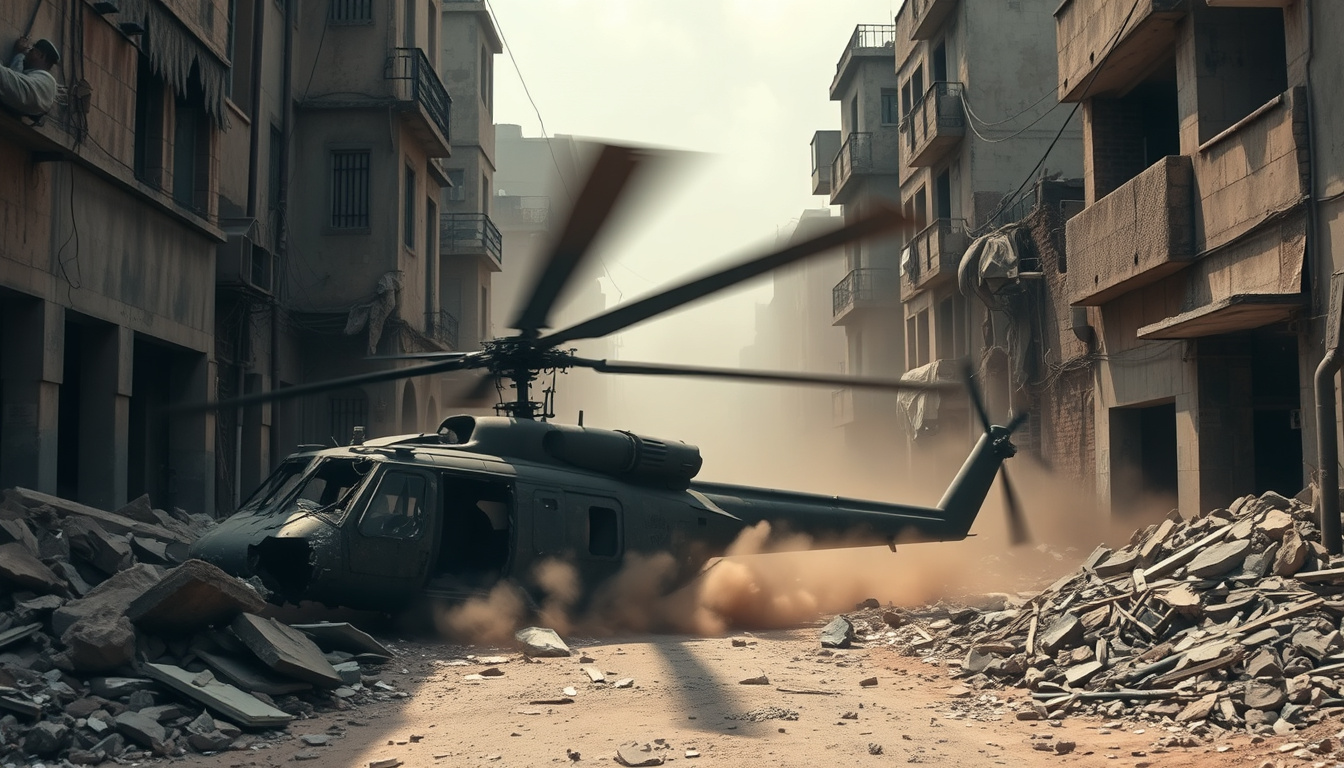

There’s a reason Ridley Scott’s Black Hawk Down still lands like a punch thirty years on — it drops you straight into the noise without much setup. Released in 2001, the film won an Oscar for Best Film Editing (with actual radio chatter from the battle woven into the soundtrack), but it tells a compressed, American-heavy version of what actually happened in Mogadishu.
Released: 2001 · Director: Ridley Scott · Battle Date: October 1993 · US Soldiers Involved: 100 · US Fatalities: 18
Quick snapshot
- Battle of Mogadishu spanned October 3–4, 1993 (Wikipedia)
- Two Black Hawks, Super Six One and Super Six Four, shot down by RPG fire (Modern War Institute)
- Gary Gordon and Randy Shughart defended Super Six Four — both posthumous Medal of Honor recipients (Wikipedia)
- Exact duration Shughart and Gordon survived at the crash site under fire
- Precise sequence of events during the final minutes at Super Six Four
- Whether all American casualties were identified before exfiltration
- September 25, 1993: A Black Hawk (Courage 53) shot down by Somali forces (Wikipedia)
- October 3, 3:30 PM: Raid begins — 100 Rangers, 12 Black Hawks (Time Magazine)
- October 3, 4:15 PM and 4:49 PM: Both Super Six birds crash (Wikipedia)
- Newer documentaries include Somali civilian accounts the film omitted (Time Magazine)
- Questions about casualty figures and body recovery remain contested (Time Magazine)
Five battle details stand out when you lay the film next to what actually happened on the ground.
| Detail | Film or common reference | What the record shows |
|---|---|---|
| Film release year | 2001 | 2001 |
| Battle location | Mogadishu, Somalia | Mogadishu, Somalia |
| US units involved | Rangers and Delta Force | Rangers and Delta Force (Task Force Ranger) |
| Helicopters downed | 2 Black Hawks | 2 Black Hawks (Super Six One and Super Six Four) |
| Medal of Honor recipients | Shughart and Gordon | Gary Gordon and Randy Shughart |
What is the real story behind Black Hawk Down?
The US raid began at 3:30 PM on October 3, 1993, with 100 US Rangers and 12 Black Hawks as part of Operation Gothic Serpent. The mission targeted Mohamed Farrah Aidid’s forces and was expected to wrap up in under an hour, according to ARSOF History (official US Army special operations records). Instead, it turned into an overnight urban firefight that did not end until a UN convoy arrived the following morning.
The mission was designed as a quick capture operation. The fact that it collapsed into 18-24 hours of sustained combat reflects how quickly elite forces can be overwhelmed when the enemy refuses to scatter and air support cannot reach them.
Background on the Battle of Mogadishu
Task Force Ranger had already tried six times to capture Aidid since October 1993. The October 3 raid was their seventh attempt. Within 20 minutes of insertion, they had captured 24 of Aidid’s personnel, including a top lieutenant, according to the Modern War Institute at West Point (military academic source). The quick initial success masked a growing threat from Somali militiamen who were already organizing in the area.
Key objectives of the US operation
The mission had a simple goal: snatch two of Aidid’s key lieutenants from a building in the Bakara Market area. The raid was planned for minimal footprint — no heavy armor, no large convoy, just fast-roping helicopters and ground teams expecting a clean extraction. The operation went sideways when two Black Hawks were hit by RPG-7 rounds fired by Somali militia who had positioned themselves in buildings with clear sightlines to the flight path.
How accurate is the movie Black Hawk Down?
The film compresses an 18-24 hour battle into roughly 2 hours and 24 minutes of screen time, which means nearly everything happens faster and more consecutively than it did. The Modern War Institute describes the actual timeline as messier — with the two helicopter crashes separated by 34 minutes and ground teams fighting through the night rather than one intense afternoon. The film also omits a September 25 Black Hawk shootdown (Courage 53) that was a direct precursor to the October 3 disaster, according to Wikipedia.
The film uses real radio chatter recordings from the battle — which makes it feel authentic — but the emotional beats and character focus are built around dramatization, not chronology.
Portrayal of helicopter shootdowns
Super Six One crashed at 4:15 PM, four blocks northeast of the Olympic Hotel. Super Six Four went down at 4:49 PM, seven blocks south of the same landmark. Both times match official records from the Modern War Institute at West Point (an official military academic institution). The film does not show the first crash site crew being rescued by an MH-6 Little Bird, a detail that actually happened.
Depiction of ground combat and rescue
Snipers at the Super Six One crash site held until extraction arrived. At Super Six Four, the situation was different. Master Sergeant Gary Gordon and Sergeant First Class Randy Shughart requested insertion three times before being allowed to land near the wreckage — the film shows the final insertion, but some sources indicate the third request was already confirmed before Gordon made it, according to Poudre Press. Both men were awarded the Medal of Honor posthumously for their actions. Michael Durant, the pilot of Super Six Four, was captured after Gordon and Shughart were killed, and his survival was not guaranteed until days later.
Were all the bodies recovered from the Battle of Mogadishu?
This question has no fully satisfying answer from public records. The bodies of some US soldiers were not recovered immediately from the crash sites, and the chaos of the overnight battle made identification and retrieval difficult. Media coverage at the time focused heavily on the American casualties being dragged through the streets — footage that shocked US audiences — but the recovery process and its timeline remain poorly documented in open sources.
According to Time Magazine (reporting from primary accounts), US media in 1993 showed Somali attackers but rarely showed the Somali casualties from that same combat — an imbalance that shaped how the battle was understood by the American public. The bodies of several US soldiers were recovered over the following days, but the exact sequence and timing of those recoveries lacks clear documentation in accessible sources.
Recovery efforts during and after battle
Survivors from the first crash site took several hours to traverse one mile to the second crash site under fire, according to Team RWB analysis. The final exfiltration involved what became known as the “Mogadishu Mile” — a desperate push across open ground while under heavy fire. The rescue convoy included Pakistani, Malaysian, and American troops from UNOSOM II, the international force that had been deployed to Somalia. Without that convoy’s arrival on the morning of October 4, the death toll on the ground would almost certainly have been higher.
Status of US and Somali casualties
Eighteen US soldiers were killed and 73 wounded, based on ARSOF History (official US Army special operations records). Somali casualties are far less certain. Some estimates place Somali deaths at over 500 and injured at over 1,000 — but these figures are reported with significant uncertainty, according to Team RWB. The actual Somali toll may have been higher, given that 1993 media coverage largely ignored Somali casualties while documenting American ones in detail.
Was Randy Shughart ever found?
Randy Shughart was recovered from the Super Six Four crash site along with Gary Gordon and Michael Durant. All three men’s remains were identified before the formal exfiltration was complete, though the specific sequence of when each was recovered versus when Durant was taken hostage is documented across multiple accounts that vary in detail. Shughart and Gordon received posthumous Medals of Honor — the nation’s highest military decoration — for their defense of the crash site.
Shughart and Gordon are remembered as heroes — but the film makes their decisions look like spur-of-the-moment heroism when the record suggests Gordon at least had been requesting insertion before the crash happened.
Shughart and Gordon’s defense of Super Six Four crash site
After Super Six Four crashed, Gordon made three requests for insertion before being cleared to approach the site. Some sources indicate Gordon had already secured confirmation for insertion before making the third request — a detail the film collapses into a single dramatic moment. Both men made their way to the crash site on a fast-rope insertion and began defending the perimeter against waves of Somali militia, protecting the wounded Durant.
Post-battle search outcomes
The Super Six Four site saw the heaviest fighting of the entire battle. After Gordon and Shughart were overrun, Durant was captured and held for several days before being released. The bodies of both men were recovered during the subsequent days, though the exact order of recovery is not always clearly stated in open sources. Their Medal of Honor citations document their final actions in detail, even if some tactical specifics remain debated.
How long did Shughart and Gordon survive?
No publicly available source gives a precise minute-by-minute account of how long Shughart and Gordon survived at the Super Six Four crash site before being overrun. Multiple accounts describe them as holding out for an extended period against sustained militia attacks, but the specific duration — whether it was 30 minutes, two hours, or longer — varies depending on the source. What is clear is that they survived long enough to make a difference, and that difference cost them their lives.
Timeline of their holdout at crash site
Based on the overall battle chronology, Super Six Four crashed at 4:49 PM on October 3. The final exfiltration did not begin until sometime after nightfall, with the convoy arriving on the morning of October 4. During that window, Gordon and Shughart held their ground at the crash site. The exact timing of when they were overrun — before, during, or after the convoy’s arrival — is reported differently across sources, according to Poudre Press.
Final actions before overrun
Their Medal of Honor citations document that both men continued to fight even as their ammunition ran low and the Somali militia closed in. They were not extracted. They died at the crash site. Their actions allowed Durant to survive long enough to be taken prisoner — a survival that itself became a major diplomatic issue in the weeks following the battle. The precise sequence of their final minutes is where the record gets murky, even though the outcome is certain.
The pattern: detailed enough to establish heroism, imprecise enough that exact timelines remain unclear — a gap the film fills with dramatic invention.
Confirmed
- 18 US soldiers killed and 73 wounded
- Two helicopters shot down (Super Six One and Super Six Four)
- Battle lasted 18-24 hours, not the film’s 2 hours 24 minutes
- Gordon and Shughart defended the Super Six Four crash site and were killed
- Michael Durant was captured and later released
Unclear or debated
- Exact duration Gordon and Shughart survived before being overrun
- Confirmed Somali casualty figures
- Precise sequence of events at the Super Six Four crash site in final minutes
- Whether all American casualties were identified before the convoy arrived
“There’s nothing worse than losing the eyes. She was just a child.”— Binti Adan, Somali survivor mother (Time Magazine)
“The mission dramatically changed when the clan fighters struck a Black Hawk, call sign Super Six One, at 4:15 PM with an RPG.”— Urban Warfare Project, Modern War Institute at West Point
For viewers who know the film, the full scope is darker than what made it to the screen. The battle lasted 18-24 hours, not a single afternoon. Somali casualties — including civilian women and children — are largely absent from the narrative the film constructed. The two Medal of Honor recipients, Shughart and Gordon, are remembered as heroes, but the precise circumstances of their final stand remain less documented than their legacy. Subsequent documentaries like Surviving Black Hawk Down have started filling in the gaps from Somali perspectives, but the dominant account in popular culture remains the one Ridley Scott told.
Related reading: Poor Things Movie – Plot, Cast and Ending Explained
menshealth.com, youtube.com, arsof-history.org, teamrwb.org, britannica.com, poudrepress.com
Ridley Scott assembled an impressive ensemble cast for Black Hawk Down, bringing the chaos of the 1993 Mogadishu battle vividly to life on screen.
Frequently asked questions
What is Black Hawk Down about?
Black Hawk Down (2001) dramatizes the October 1993 Battle of Mogadishu, in which a US raid targeting Somali warlord Mohamed Farrah Aidid went catastrophically wrong when two Black Hawk helicopters were shot down over Mogadishu, Somalia.
Who starred in Black Hawk Down?
The film stars Josh Hartnett, Ewan McGregor, Tom Sizemore, and others. It was directed by Ridley Scott, with a screenplay by Ken Nolan and co-production by Jerry Bruckheimer.
Is Black Hawk Down based on a true story?
Yes. It is based on Mark Bowden’s book and the real Battle of Mogadishu (October 3–4, 1993), but the film compresses the timeline, focuses on US soldiers, and omits Somali casualties and perspectives.
Where can I stream Black Hawk Down?
Black Hawk Down is available on streaming platforms — check current listings for availability in your region.
Is there a Black Hawk Down 2?
There is no direct sequel. Netflix released the documentary Surviving Black Hawk Down (2024), which adds Somali civilian perspectives the original film did not include.
What is the Battle of Mogadishu?
The Battle of Mogadishu was a 18-24 hour urban firefight in Somalia on October 3–4, 1993, during Operation Gothic Serpent. US Task Force Ranger troops fought Somali militia after two Black Hawk helicopters were shot down.
How many US soldiers died in Mogadishu?
Eighteen US soldiers were killed and 73 wounded during the Battle of Mogadishu. The battle is regarded as the bloodiest single firefight for US troops since Vietnam.
Related stories



Rachel Bennett leads fact-checking, source verification and corrections at Australia Current.