
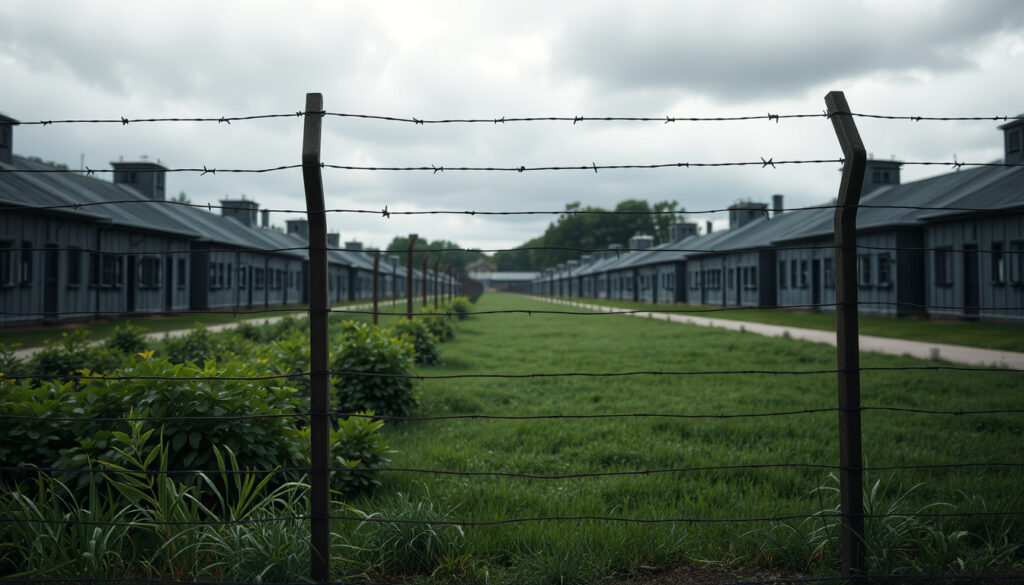
There’s a moment in John Boyne’s novel where an 8-year-old German boy peers through a fence and sees, for the first time, a world he cannot begin to understand. Bruno doesn’t know what a striped pajamas means or why people behind wires look the way they do — and that innocence is exactly the point. Published in 2006 and adapted for film in 2008, this story has sold seven million copies and sparked fierce debate about how we teach the Holocaust to new generations.
Author: John Boyne · Publication Year: 2006 · Film Release Year: 2008 · Setting: Nazi-occupied Poland · Protagonist Age: 8 (film) / 9 (book)
Quick snapshot
- Plot derived from novel and film sources (Wikipedia)
- Works of fiction set in historical context (Holocaust Centre North)
- Whether Boyne has publicly addressed specific accuracy critiques
- Exact reception data beyond sales figures
- Novel published 2006 → Film released 2008 → Sales hit 7 million by 2016 (Holocaust Centre North)
- Ongoing academic criticism surfacing 2025 (Holocaust Centre North)
| Field | Value |
|---|---|
| Author | John Boyne |
| Book Publisher Year | 2006 |
| Film Director | Mark Herman |
| Runtime | 94 minutes |
| Main Characters | Bruno, Shmuel |
Is the film The Boy in Striped Pyjamas based on a true story?
This is the question most readers and viewers ask before engaging with the story, and the answer matters for understanding what you’re about to read or watch.
Novel origins
The Boy in the Striped Pyjamas is a work of fiction. John Boyne published the novel in 2006, and it has sold seven million copies as of 2016 (Holocaust Centre North). The book draws on historical facts about the Holocaust to tell its story, but the characters, events, and circumstances are entirely invented. Many readers, however, believe it recounts real events — a misconception the author has acknowledged and that has fueled ongoing debate in Holocaust education circles.
Historical context
The film adaptation, released in 2008 and directed by Mark Herman, is set in Nazi-occupied Poland at an extermination camp resembling Auschwitz (Wikipedia). This setting grounds the fictional narrative in one of history’s most documented atrocities, which is central to why the story carries such emotional weight — and why critics scrutinize it so closely.
The implication: the story uses real history as its stage, but the actors and their fates are invented. Understanding this distinction shapes how educators and readers approach the work.
What actually happened to Bruno in The Boy in the Striped Pajamas?
Bruno’s fate is the moment the entire narrative builds toward, and it arrives with devastating simplicity.
Final adventure
In the film’s version, Bruno is 8 years old; in the book, he is 9. He is the son of SS officer Ralf, and his family has moved from Berlin to a house adjacent to the camp (Wikipedia). From his new home, Bruno mistakes the camp for a farm and its prisoners for people simply wearing striped pajamas. He befriends Shmuel, a Jewish boy his age, through the barbed wire fence between their worlds.
When Shmuel’s father disappears from a work party, Bruno decides to help find him. He digs under the fence, changes into the striped garments he sees the prisoners wearing, and slips inside.
Gas chamber fate
Both boys are captured and marched into a gas chamber where they are killed (Wikipedia). Before the end, Bruno calls Shmuel his best friend — “You’re my best friend Shmuel. My best friend for life,” the character says (Book Journey). The moment is meant to crystallize innocence destroyed by the Holocaust system, as analysis from The Ending Explained frames it.
Bruno dies because the system he lived beside does not recognize innocence. His German privilege could not shield him from the machinery his father served.
The catch: the story’s power depends on the reader accepting that a child could be this ignorant of what surrounded him. Critics note this is precisely where the historical accuracy breaks down.
What happened to Bruno’s family after he died?
The emotional core shifts after Bruno’s death, from the boy’s perspective to the devastation it leaves behind.
Parents’ discovery
The story ends with Bruno’s family devastated upon realizing his death (Wikipedia). Mother Elsa, who was initially unaware of the camp’s true nature, learns the truth alongside the rest of the world she never wanted to see. Father Ralf confronts the consequences of his own position in a way no comfort can mend.
Family aftermath
The film is criticized for centering emotional tragedy on the German family’s loss rather than the systematic murder of Jews (Indiana University Libraries). This narrative choice — making Nazi officers’ children the objects of grief rather than their victims — sits at the heart of why the work divides educators and historians.
What this means: the story asks readers to mourn a German boy while audiences know that for every Bruno in that world, thousands of Shmuels died nameless. The asymmetry is deliberate and uncomfortable.
What happens to the commandant at the end of The Boy in the Striped Pyjamas?
The commandant — Bruno’s father Ralf — survives the immediate aftermath, but his fate within the story reflects the broader accountability the narrative probes.
Commandant’s response
Ralf’s discovery of Bruno’s body at the camp gates, or the moment he realizes what has happened, drives his transformation from distant authority figure to broken parent. The film leaves his ultimate future somewhat open, but the camp’s operations continue regardless of his personal anguish.
Camp consequences
Critics argue the story perpetuates myths by suggesting that camp commandants’ families were ignorant of what occurred inside the fences (YouTube Historical Analysis). In reality, the families of SS officers typically knew far more than this narrative implies. The Ending Explained frames the tragedy as innocence destroyed, but historians question whether such innocence was ever truly possible in that context.
The trade-off: using a German child’s death to personalize the Holocaust resonates emotionally with audiences but risks eclipsing the actual victims in the telling.
Why did Bruno’s father shave Bruno’s head?
This detail surfaces in both the book and film, and readers often ask what drives it within the narrative.
Lice prevention
In the story, Ralf shaves Bruno’s head as a lice prevention measure when he returns from what his father believes is a stay at a distant boarding school. The shaved head also serves a darker symbolic purpose — it makes Bruno resemble the prisoners more closely when he eventually wears the striped pajamas, reducing the visual gap between his world and theirs.
Family precautions
Beyond lice, the shaved head signals the family’s isolation within the command structure. They are apart from German society, in a place where rules operate differently, and even small grooming decisions reflect the militarized environment. Bruno’s altered appearance also foreshadows his inability to stand out when he enters the camp — stripped of identity, he becomes indistinguishable from the others.
A shaved head in this context is not merely hygiene — it is the first step in Bruno’s transformation from privileged outsider to anonymous prisoner.
What to watch: the moment when Bruno’s shaved head first appears in the film marks the visual turn toward the story’s inevitability.
What we know and what remains unclear
Confirmed facts
- The novel was published in 2006 and adapted into a 2008 film
- Both the book and film are works of fiction, not based on a true story
- The protagonist is 8 years old in the film, 9 in the book
- Bruno and Shmuel die together in a gas chamber
- The work is used in UK schools for Holocaust education
Points of uncertainty
- Specific details about John Boyne’s public statements on accuracy debates
- Exact box office or award data for the film
- How non-English-speaking regions have received the work beyond sales figures
Notable perspectives on the story
“You’re my best friend Shmuel. My best friend for life.”
— Bruno, speaking to Shmuel before their death (Book Journey)
“It is important to understand that the book is a work of fiction. The events portrayed could never have happened.”
— Holocaust Centre North (Holocaust Centre North)
“The Boy in the Striped Pajamas is a Holocaust story centered around the death of a German child.”
— Indiana University Libraries Blog (Indiana University Libraries)
Children like Shmuel would not survive long at Auschwitz if too young to work, and casual conversations through unguarded fences were impossible there — per Holocaust educators at Kveller.
Related reading: Poor Things Movie Guide · Anatomy of a Scandal Guide
The story’s poignant exploration of innocence amid Holocaust horrors extends to Bruno’s fate and family dynamics, as detailed in plot summary, ending and themes.
Frequently asked questions
Who is Lieutenant Kotler in The Boy in the Striped Pyjamas?
Lieutenant Kotler is a Nazi soldier who serves in the household and at the camp. He beats Shmuel after Bruno denies knowing him, showcasing the brutal enforcement of camp discipline. He also influences Bruno’s sister Gretel’s growing Nazi sympathies.
What is the setting of The Boy in the Striped Pyjamas?
The story is set in Nazi-occupied Poland at an extermination camp resembling Auschwitz. The family lives in a house on the camp’s edge, with Bruno able to see the camp from his window.
Who is the protagonist Bruno?
Bruno is a 9-year-old German boy (8 in the film) whose father, SS officer Ralf, moves the family to a home adjacent to the concentration camp. Bruno is innocent, curious, and unaware of the Holocaust’s realities.
What is the main conflict in the story?
The central conflict involves Bruno’s forbidden friendship with Shmuel across the camp fence, set against the backdrop of his father’s role in running the extermination camp. The tension builds toward the tragic ending.
Where can I watch The Boy in the Striped Pyjamas?
The film is available on Netflix and various streaming platforms. Search for “The Boy in the Striped Pyjamas” or “The Boy in the Striped Pajamas” (North American spelling) to locate viewing options.
Is there a PDF version of the book?
Legal PDF versions may be available through authorized retailers like Amazon Kindle or Google Books. The novel remains in print and widely available through libraries and bookstores.
How does Gretel change in the story?
Gretel, Bruno’s sister, evolves from a relatively ordinary girl into a Nazi sympathizer influenced by tutor Herr Liszt and Lieutenant Kotler. Her transformation reflects how Nazi ideology permeated even family life.
Related reading
- Wikipedia — Full film details and production credits
- Holocaust Centre North — Critical analysis of educational use
- SparkNotes — Complete book plot summary
- The Ending Explained — Ending analysis and symbolism
For readers seeking Holocaust education that centers survivor testimony, the choice is clear: pair this novel with Schindler’s List or The Pianist, or seek out documented first-person accounts. The Boy in the Striped Pyjamas can open a door, but it should not be the room you stay in.
Related stories




Ryan Hughes is Senior Reporter at Australia Current, covering breaking stories and explainers.